Your Education Was the Foundation. Here’s How Board Certification Turns It Into a Career.
AANWP provides non-exam board certification for natural wellness practitioners whose education meets defined professional standards, allowing practitioners to hold a recognized professional identity as a board certified natural wellness practitioner. Board certification gives natural wellness professionals a clear, externally reviewed credential that communicates their training to clients, peers, and professional collaborators.
There is a moment most natural wellness practitioners remember. It does not happen in the classroom. It happens after – when the education is completed, the notebooks are closed, and someone in real life asks the question that changes the weight of everything you spent the last year or two building.
“What are your credentials?”
For some practitioners, the question comes from a prospective client sitting across from them for the first time. For others, it comes from a family member who still isn’t quite sure what to make of the work. Sometimes it comes from a colleague, a referral partner, or a wellness center that wants to bring someone on.
And in that moment – after all the coursework, all the studying, all the genuine investment in understanding how to help people – many trained natural wellness professionals discover a gap they were never warned about. The training was real. The education was meaningful. But without a formal credential attached to it, that training is almost invisible to the people who need to trust it.

This is not a reflection of how hard you worked or how much you know. It is a structural problem in a field that has historically moved faster than its professional infrastructure. Natural wellness education has grown, diversified, and deepened for decades. The professional markers that help others recognize that education has not always kept pace. Board certification is how that gap closes.
What the Gap Actually Looks Like
Consider a practitioner who spent two years completing coursework in holistic nutrition, herbalism, and lifestyle wellness. She built real knowledge. She began working with clients informally – helping a friend manage stress-related symptoms, supporting a neighbor through a significant dietary transition, eventually building a small referral network.
When she finally decided to formalize her practice, she ran into the same wall many practitioners hit. She had no single institutional credential that captured the breadth of her training. She had certificates from multiple programs but no unified professional identity. She was not underqualified. She was under-credentialed and the distinction matters enormously in a field where clients are trying to make informed decisions about who they trust with their health. AANWP Board certification exists to solve that exact problem.

What Board Certification Does for Your Career
The American Association of Natural Wellness Practitioners provides non-exam board certification for natural wellness practitioners. The process is built around one core premise: the education you have already completed has value, and it deserves to be formally reviewed and recognized.
When you apply for AANWP board certification, your existing education and credentials are evaluated by an independent board against defined professional standards. This is not a test of your knowledge in the conventional sense. It is a review of the training you have already done – a formal process that determines whether that training meets the standard required for board certified standing.
That shift is smaller than it sounds and larger than it looks. On paper, it is a credential. In practice, it is a professional identity – a clear, recognizable signal that your work has been reviewed by a professional body and found to meet a defined standard. It is the difference between saying “I completed training in natural wellness” and saying “I am board certified.” One is a description. The other is a credential. They are not the same thing in the mind of the person deciding whether to trust you.
You can review the board certification process and eligibility criteria here: https://aanwp.com/board-certification/.
Why Natural Wellness Specifically Needs This Standard
Most fields with formal credentialing systems have them because the training path is standardized. You complete a defined program at a state- accredited institution and the credential follows naturally. Natural wellness does not work that way – and that is one of its strengths. Practitioners come to the field through herbal medicine, naturopathic training, integrative nutrition, lifestyle wellness programs, and dozens of other pathways. The diversity of educational routes reflects the breadth of the field itself.
But that diversity also creates a challenge. When the training paths vary widely and there are no shared professional markers, clients and peers cannot easily distinguish between a practitioner who spent years building serious expertise and someone who completed a weekend program and printed a certificate.
Board certification provides that marker. It does not flatten the diversity of the field. It gives that diversity a professional home – a place where varied educational backgrounds are reviewed against a consistent standard and recognized accordingly.
The practitioners who benefit most from that recognition are exactly the ones doing the most serious work: the practitioners who invested real time in real education and want the professional world to see it.
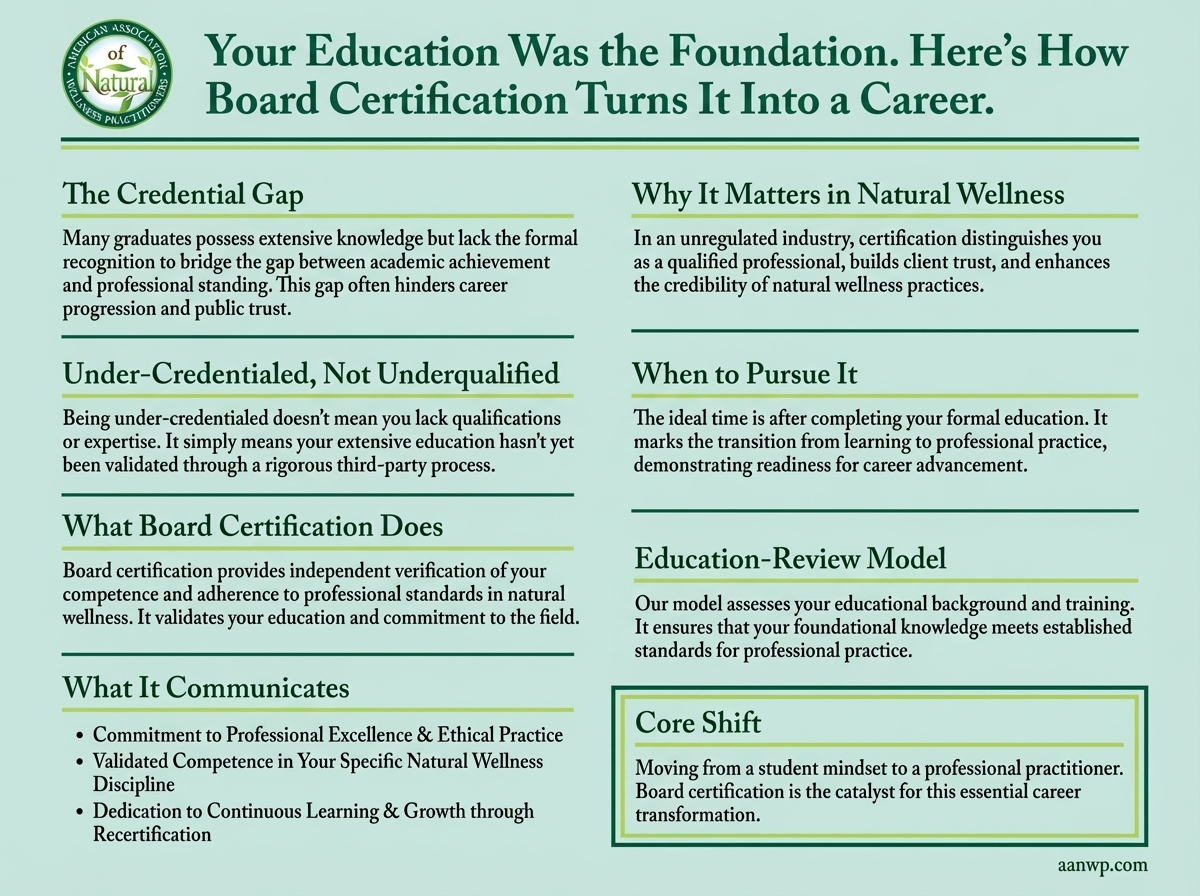
What “Board Certification” Communicates
When a natural wellness practitioner holds board certification, three things become true that were not true before. First, their education has been externally reviewed. Not self-described, not informally acknowledged – reviewed by an independent board against a defined professional standard. That review is documented. It can be referenced, verified, and communicated clearly. Second, they belong to a professional body. AANWP is a professional association built specifically for natural wellness practitioners. Certification connects the practitioner to that community – and to the standards that community maintains. That belonging signals something to clients and peers that no solo credential can.
Third, and most importantly for many practitioners: the awkward explanation goes away. The moment a practitioner can say “I am board certified through AANWP” without a three-paragraph qualifier, the conversation changes. Clients understand what it means even if they do not know every detail of the certification process. It communicates seriousness, standards, and accountability in a way that a list of completed courses cannot.
You can explore what the AANWP advisory board here: https://aanwp.com/advisory-board/.
Whether You Are Just Starting or Years In
One of the most persistent myths about board certification is that it is something you pursue after you have already built a career – a reward for experience rather than a foundation for it. The reality is the opposite. Board certification is recognition of education, not longevity. And the practitioners who benefit most from pursuing it early are exactly the ones who are still in the process of building their client base and professional reputation.
Beginning your practice already holding a board certified identity changes the first impression you make – on clients, on referral sources, on anyone who is trying to decide whether your work is worth their trust. You do not spend the first two years of your career explaining your background. You spend those years practicing with a credential that does the explaining for you. For experienced practitioners, the value is different but equally real. Many have been doing meaningful, skilled work for years without ever formalizing the professional identity behind it. Board certification gives that work a name – a credential that reflects the investment they have already made and connects them to a professional community that recognizes it.

On the Non-Exam Model
AANWP uses an education-review model for board certification rather than a formal competency exam. This is a deliberate choice that reflects how natural wellness education works.
Because practitioners build their expertise through diverse and often specialized programs rather than a single standardized institutional path, an exam-based model would struggle to capture the breadth of what qualified practitioners know. The board review process evaluates the education that practitioners have genuinely completed and determines whether it meets the standard – without requiring them to compress years of varied education into a single testing format.
For practitioners who do want exam-based validation in addition to or instead of education review, the American Natural Wellness Practitioners Board (ANWPB) offers an exam-based board certification pathway. Some practitioners pursue AANWP certification first to establish a formal professional identity and later choose ANWPB as the next step. Both credentials serve natural wellness practitioners. They reflect different professional goals, not different levels of seriousness.
You can explore the ANWPB Natural Medicine exam here: https://aanwp.com/anwpb-naturopathy-natural-medicine/ and the ANWPB Nutrition exam here: https://aanwp.com/anwpb-nutrition-exam/.

The Credential Your Education Has Already Earned
Most natural wellness practitioners who pursue board certification say the same thing afterward: they wish they had done it sooner. Not because the process is difficult. Not because the credential opens doors that were otherwise impossible to open. But because of how it changes the way they carry the work. There is a difference between knowing you are trained and knowing your training has been reviewed, recognized, and made official. The knowledge is the same. Professional confidence is not. You completed the education. You built the knowledge. You have been doing the work – or you are getting ready to. The credential that reflects all of that is not waiting for you to earn it. It is waiting for you to claim it.