What Non-Exam Board Certification
Demonstrates in Professional Practice
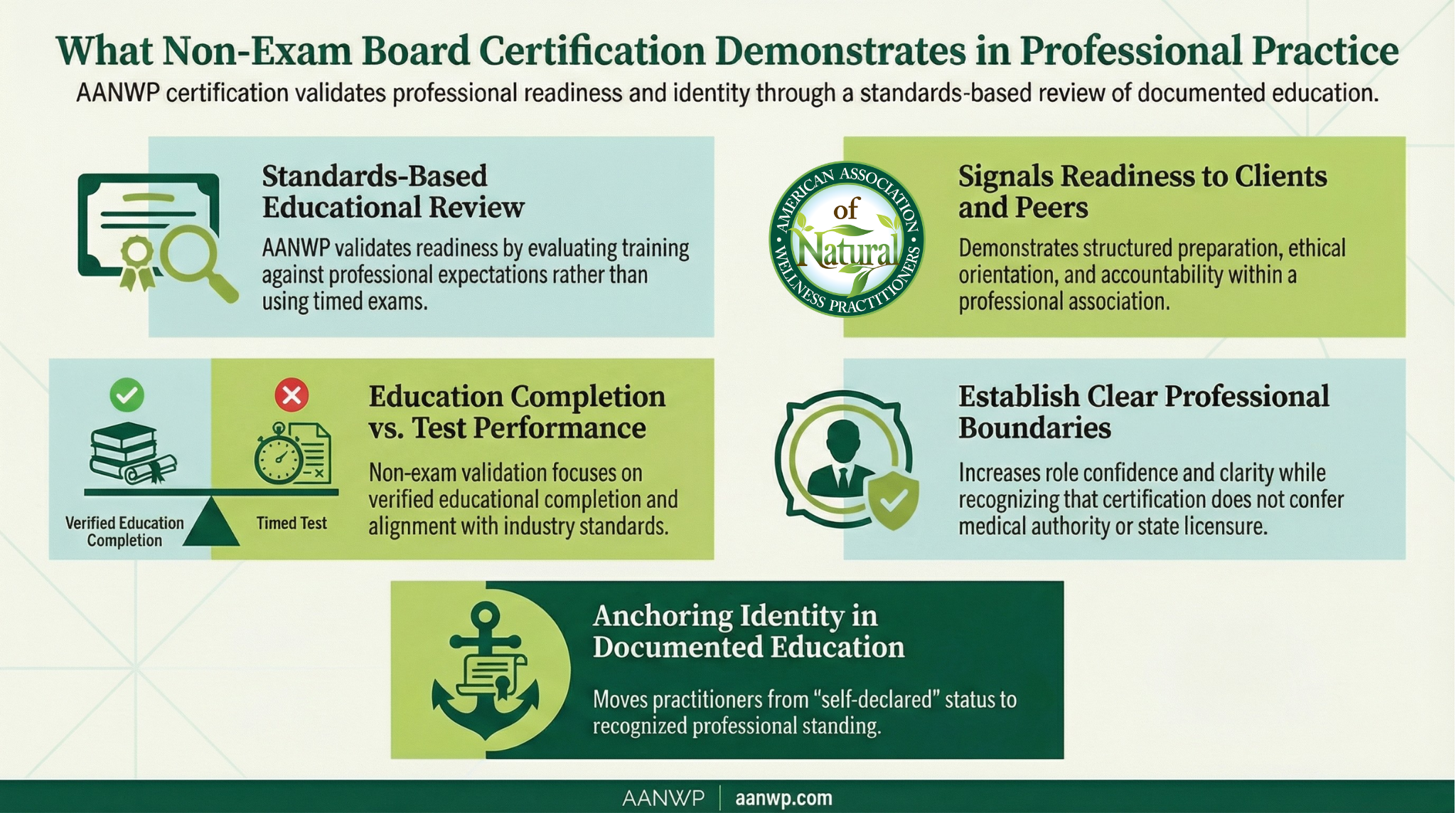
AANWP non-exam board certification validates that a practitioner’s education has been reviewed against defined professional standards. It signals structured preparation and documented readiness without requiring a formal examination. The credential clarifies professional identity while not conferring medical authority or state licensure.
In natural wellness professions, credibility can feel difficult to define. Many practitioners invest years in education, mentorship, self-study, and client experience, yet still struggle to answer a simple question:
How do I clearly demonstrate that I am professionally prepared?
In fields where licensing structures vary and role definitions are not always standardized, visible validation becomes important. This is where non-exam board certification plays a distinct role.
The American Association of Natural Wellness Practitioners (AANWP) provides a non-exam board certification pathway that validates preparation through structured education review and standards-based evaluation rather than formal testing. It addresses a specific professional need: demonstrating readiness without relying solely on self-description or informal reputation.
This article explains what non-exam board certification demonstrates in real professional practice, what it communicates to clients and peers, and how to interpret it responsibly within the AANWP framework.

Why Professional Validation Matters in Natural Wellness
Natural wellness is broad and diverse. Practitioners may focus on lifestyle support, nutrition education, holistic models, herbal traditions, or integrative wellness approaches.
Because the field is varied, public interpretation of titles can become inconsistent.
Without visible validation, practitioners may experience:
- Identity confusion
- Difficulty explaining their role
- Client skepticism
- Challenges distinguishing themselves from hobbyists
- Professional isolation
Professional validation does not replace skill. It clarifies preparation.
Within AANWP, practitioner board certification serves as a visible marker that education has been reviewed against defined professional expectations.
AANWP Board Certification Overview:
https://aanwp.com/board-certification/

Education Review as Structured Validation
Education review is sometimes misunderstood as passive. In reality, it is standards-based.
The AANWP process asks:
Does the applicant’s education reflect core competencies expected in natural wellness practice?
Is the preparation coherent and relevant?
Does the background support responsible professional conduct?
This review creates institutional alignment.
AANWP also provides Scope of Practice Guidelines to reinforce boundary awareness:
https://aanwp.com/scope-of-practice-for-non-state-licensed-practitioners/
That connection between preparation and scope clarity strengthens credibility.
What Non-Exam Board Certification Is Designed to Demonstrate
Non-exam board certification validates that a practitioner’s education aligns with established professional standards.
The AANWP review process evaluates:
- Relevance of completed education
- Alignment with natural wellness practitioner expectations
- Documentation of training
- Consistency of preparation
- Ethical orientation and scope awareness
Rather than assessing knowledge through a timed exam, AANWP evaluates the practitioner’s educational foundation through structured review.
The emphasis is not on memorization. It is on documented education.
Qualifications and standards are outlined through AANWP’s certification framework:
https://aanwp.com/board-certification/
What This Certification Signals to Clients
Most clients do not deeply analyze credentials. They look for clarity and legitimacy.
When a practitioner holds AANWP non-exam board certification, it signals:
- Structured training has been completed.
- Education has been reviewed, not self-declared.
- The practitioner aligns with defined professional standards.
- Professional boundaries are recognized.
In an environment where anyone can create a website and adopt a title, standards-based validation helps differentiate structured preparation from informal interest.
It reduces the perception of improvisation.
What It Signals to Professional Peers
Within practitioner communities, visible validation contributes to stability.
To peers and collaborators, AANWP certification signals:
- Commitment to recognized professional pathways
- Respect for documented preparation
- Willingness to align with shared standards
- Accountability within a professional association
AANWP maintains an Advisory Board that contributes to governance and professional oversight: https://aanwp.com/advisory-board/.
That oversight reinforces institutional seriousness.
The Difference Between Non-Exam and Exam-Based Validation
Both validation pathways serve legitimate purposes.
Exam-based certification demonstrates performance under standardized testing conditions.
Non-exam board certification demonstrates:
- Verified educational completion
- Alignment with professional standards
- Documented preparation
- Structured readiness
The distinction is not about difficulty. It is about method.
Some professionals are prepared through structured academic or institutional pathways that already include evaluation. For them, standards-based education review may be an appropriate validation mechanism.
AANWP operates within the non-exam validation model.
What Non-Exam Board Certification Does Not Claim
Clarity protects credibility. Certification validates preparation. It does not override regulatory realities.
AANWP non-exam board certification does not:
- Guarantee client outcomes
- Imply state licensure
- Confer medical authority
- Replace ethical responsibility
- Eliminate the need for continued learning
Practitioners are encouraged to review legal and ethical guidance resources:
- Legal & Ethical Essentials Video:
https://aanwp.com/legal-ethical-essentials/ - Naturopathic State Laws Map:
https://aanwp.com/naturopathic-state-laws/
Professional Identity and Psychological Clarity
Many practitioners underestimate the internal impact of formal recognition.
When preparation is reviewed and recognized, practitioners often experience:
- Increased confidence
- Clearer role language
- Stronger boundaries
- Reduced defensiveness
- Greater steadiness in professional conversations
This internal clarity improves external communication.
Professional identity becomes anchored in defined standards rather than fragile self-description.

Why Education-Based Validation Matters in Early Professional Stages
For practitioners in early career phases, visible validation reduces uncertainty.
Common early-stage questions include:
Am I ready?
Will clients question me?
Do I have enough formal backing?
AANWP non-exam board certification confirms that documented preparation meets defined expectations.
It provides reassurance without requiring examination as the sole pathway to legitimacy.
Standards and Professional Consistency
When practitioners align with shared standards, the field becomes more coherent.
Consistency improves:
- Public understanding
- Peer collaboration
- Communication clarity
- Long-term professional stability
AANWP also offers accreditation pathways for schools and programs, contributing to ecosystem consistency: https://aanwp.com/aanwp-anwpb-accreditation/.
Practitioner certification and educational accreditation together strengthen professional clarity.
Accountability and Ethical Signaling
Non-exam board certification communicates ethical orientation.
Because preparation is reviewed against defined expectations, it suggests:
- Awareness of professional boundaries
- Commitment to responsible conduct
- Alignment with organized professional frameworks
Ethical clarity often strengthens professional standing more than marketing language.

The Broader Effect on the Profession
When more practitioners align with defined standards, the profession benefits.
Visible standards support:
- Increased public trust
- Clearer differentiation
- Reduced ambiguity in titles
- Stabilized identity formation
- Improved long-term reputation
Professional ecosystems strengthen when validation is visible and understood.
When Non-Exam Board Certification Is Most Appropriate
AANWP non-exam board certification may be appropriate if you:
- Have completed structured education
- Want recognized validation of preparation
- Prefer standards-based review rather than testing
- Are establishing professional identity
- Want clarity without unnecessary complication
It may not be necessary if you are still defining your educational direction or preparing for exam-based validation immediately.
Choosing timing wisely supports long-term credibility.
A Grounded Interpretation
At its core, AANWP non-exam board certification demonstrates that a practitioner’s education has been reviewed and aligned with defined professional expectations.
- It signals preparation, not perfection.
- It signals readiness, not guaranteed outcomes.
- It signals professional identity anchored in documented education.
When communicated accurately and practiced responsibly, it becomes a steady foundation for professional clarity.
Common Misconceptions
“If there’s no exam, it isn’t meaningful.”
Meaning is determined by standards, not format.
Education-based validation is meaningful when:
- Criteria are clearly defined
- Documentation is required
- Preparation is reviewed
- Professional alignment is evaluated
The absence of an exam does not eliminate rigor when review standards are maintained.
“Certification makes someone an expert.”
Certification validates preparation. Expertise develops through continued learning and experience.
“If I’m competent, I don’t need certification.”
You may indeed be competent. Certification clarifies competence to those who cannot directly observe your work.