

Hydration Is a Mineral Story: Why Water Alone Does Not Get You There
Real hydration depends on minerals, not water volume alone. Water follows sodium, potassium, magnesium, and trace minerals into the cells, so a client can drink steadily and still feel the signs of dehydration when those minerals are missing. This piece explains the physiology and shows how a practitioner translates it into simple, food-first changes a client can act on. It reflects the kind of practitioner reasoning ANWPB board certification supports.
A client tells you she drinks water all day. The bottle is always within reach, refilled three or four times before noon, and she is proud of the habit because someone once told her that eight glasses was the goal and she has more than met it. Yet she still describes the same cluster of complaints she arrived with: a wall of fatigue around three in the afternoon, a head that feels cottony during long calls, calves that knot at night, and a brief gray swim of lightheadedness when she stands up too quickly. She has done everything the popular advice told her to do, and she is frustrated that the water has not delivered what she was promised.
The temptation in that moment is to tell her to drink even more. It is the obvious move, and it is usually the wrong one. Real hydration is not a volume problem solved by pouring more liquid into the body. It is a balance problem, and the variable that does the balancing is not water at all. It is the minerals dissolved in that water and in the food around it. Until those minerals are part of the conversation, more water can leave a client exactly where she started, and sometimes a step behind.

Water Alone Can Dilute What the Body Is Trying to Balance
Hydration, at the cellular level, is governed less by how much fluid a person drinks and more by where that fluid goes once it is inside. Water follows minerals. The body moves fluid into and out of cells by managing the concentration of dissolved particles, mostly sodium and potassium, on either side of the cell membrane. That concentration, called osmolality, is what the body actually defends. When a person drinks a large volume of plain water quickly, the mineral concentration of the blood drops for a time, and the body responds by shifting some of that water out of circulation and eventually releasing it. The fluid passes through. It does not necessarily land where the client needs it.
This is why a person can sip steadily all day and still feel under-hydrated. The water arrives, dilutes the blood slightly, and leaves. The cells that needed it never received a strong enough signal to take it up and hold it, because that signal is carried by minerals. A practitioner who understands how the body defends plasma osmolality stops treating the water bottle as the finish line. The question is no longer how many ounces a client drank. The question is whether the minerals were present to direct that water to the tissues that were asking for it.

The Major Electrolytes and Why Their Ratios Matter
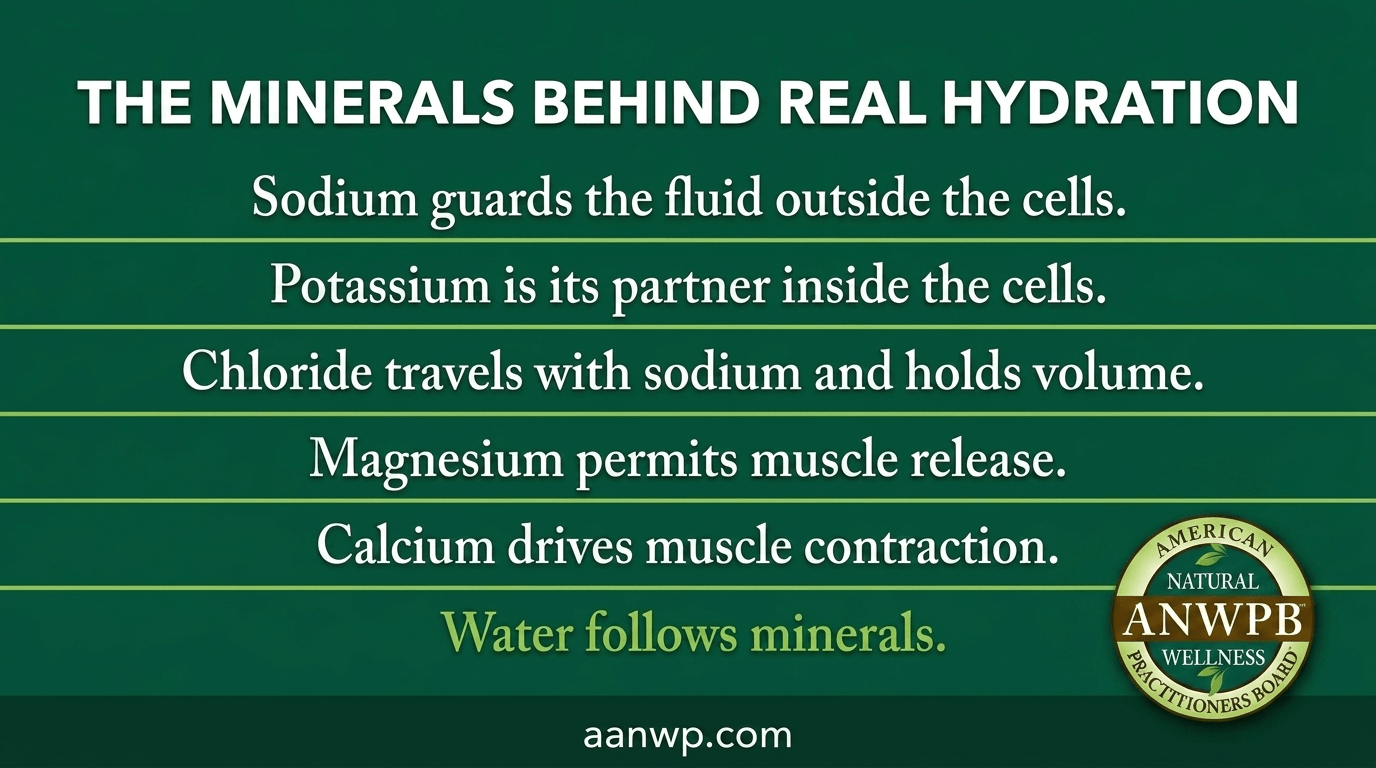
The electrolytes that do the heavy lifting in fluid balance are sodium, potassium, chloride, magnesium, and calcium. Sodium is the principal mineral in the fluid outside the cells, and it is the one the body guards most carefully. Potassium is its counterpart inside the cells. The two work in a continuous exchange, and the relationship between them, not the level of either one alone, is what keeps fluid distributed correctly and keeps nerves and muscles firing on schedule. When a client lives on processed convenience food, the irony is that sodium intake is often high while potassium intake is low, so the ratio drifts away from the balance the body needs for steady fluid distribution, even when total sodium looks adequate.
Magnesium and calcium add another layer. Magnesium is a cofactor in hundreds of enzymatic reactions and plays a direct role in muscle relaxation, which is why a shortfall can show up as the nighttime calf cramps that client described.
Calcium and magnesium operate in a kind of push and pull at the muscle level, with calcium driving contraction and magnesium permitting release. A client who is replacing fluids but not minerals can hold plenty of water and still cramp, because the mineral that governs muscle release is not keeping pace with demand. Reading these signs as a mineral question rather than a water question, and understanding magnesium’s role in muscle function, is the shift that changes the recommendation.
Chloride rounds out the major electrolytes and tends to travel with sodium, helping maintain the fluid volume outside the cells and supporting the acid-base balance the body keeps within a narrow band. Behind all of these minerals sits a regulatory system the practitioner does well to respect. The kidneys, prompted by hormones such as aldosterone, decide moment to moment how much sodium to hold onto and how much to release, and they adjust water handling to match. This is why a single day of heavy intake rarely tells the whole story. The body is constantly tuning the mineral concentration of the blood, and a client’s symptoms often reflect the running balance of intake and loss over weeks, not the contents of this morning’s glass.
Trace Minerals: The Small Inputs With Outsized Roles
Below the major electrolytes sits a quieter group, the trace minerals, present in the body in milligram or microgram amounts but disproportionately important to how well the larger system runs. Zinc, copper, manganese, selenium, chromium, and others are not the minerals that move fluid directly, but they are the cofactors that keep the machinery of mineral handling, energy production, and antioxidant defense working. A practitioner who only ever thinks about sodium and potassium is reading half the page.
Zinc, for example, is involved in the enzymes that help regulate fluid and acid-base balance, and it competes with copper for absorption, so a client supplementing one heavily without attention to the other can quietly tip a ratio that matters. Selenium supports the antioxidant systems that protect cells under metabolic stress, including the stress of repeated dehydration and rehydration cycles.

These minerals do not announce themselves the way a leg cramp does, which is exactly why they get missed. The value a practitioner brings is the willingness to consider the full mineral picture, including the inputs that produce no obvious symptom but shape how resilient a client’s hydration actually is over time.
Chromium and manganese round out the picture in their own quiet ways. Chromium participates in the body’s handling of glucose, which matters because energy stability and hydration are felt together by the client who hits an afternoon slump. Manganese serves as a cofactor for enzymes involved in antioxidant defense and metabolism. None of these trace minerals works in isolation, and that is the deeper point. The body runs on a web of mineral cofactors that support one another, and pulling one out of balance can ripple into the others. The practitioner who thinks in terms of the whole web, rather than chasing a single mineral, gives a client the steadiest foundation for hydration that actually holds.
The most reliable source of trace minerals is not a supplement aisle. It is a varied diet built on mineral-dense whole foods: leafy greens, nuts and seeds, shellfish and other animal proteins, legumes, and unrefined foods that still carry the mineral content refining strips away. Mineral-rich broths, a little unrefined salt in place of heavily processed table salt, and produce grown in healthier soil all contribute. The practitioner’s role is to help a client build a pattern of eating that supplies whole-food sources of trace minerals consistently, so that hydration has the raw materials it depends on rather than relying on water to do a job water cannot do alone.
Heat, Sweat, and the Summer Mineral Gap
Nothing makes the mineral side of hydration more visible than a hot season. Sweat is not plain water. It carries sodium in meaningful amounts, along with smaller quantities of potassium, magnesium, and chloride, which is why a client who trains or works outdoors through summer can drink generously and still feel worse as the day wears on. The water replaces the volume that was lost, but it does not replace the minerals that left with it, and the gap between the two is where the cramping, the headaches, and the flat, drained feeling tend to live. A practitioner who notices a seasonal pattern in a client’s complaints has a strong clue that minerals, not fluid volume, are the variable to address.
The practical adjustment is straightforward once the pattern is named. A client losing minerals through heat and exertion benefits from replacing them deliberately rather than relying on water alone to set things right.

That can mean salting food a little more intentionally during heavy-sweat weeks, choosing potassium-rich and magnesium-rich foods around activity, and treating a mineral-bearing drink as the recovery choice after a long, hot session rather than reaching only for the water bottle. The goal is not to push electrolytes on everyone year round. It is to match replacement to loss, so that a client’s hydration keeps pace with what summer actually takes out of them.

Translating Mineral-Aware Hydration Into Client Conversations
None of this lands with a client if it arrives as a chemistry lecture. The practitioner’s craft is translation, taking the physiology and turning it into something a person can act on this week. A useful first move is to reframe the goal out loud. Instead of asking a client to hit a water target, you ask them to notice the signals that have nothing to do with thirst: the afternoon energy drop, the cramp at night, the lightheadedness on standing, the low-grade headache that water alone never quite clears. Naming these as possible mineral signals rather than water deficits gives the client a new lens, and it sets up the change you are about to suggest.
From there the recommendation becomes concrete and small. A pinch of unrefined salt and a squeeze of citrus in the first large glass of the day.
A potassium-rich food at most meals. A magnesium-bearing food in the evening for the client whose cramps cluster at night. Broth treated as a deliberate mineral source rather than an afterthought. The point is not to medicalize a glass of water. It is to make sure the water a client already drinks has the mineral company it needs to actually hydrate. When clients feel the difference, often within days, the lesson holds better than any number on a bottle ever did.
It is worth saying plainly that mineral-aware hydration is not a push toward constant supplementation. Food comes first, and for most clients a varied, whole-food diet plus a sensible amount of unrefined salt supplies what they need without a cabinet full of capsules. Supplements have a place when a specific shortfall is identified and food alone is not closing the gap, but the practitioner who leads with food keeps the plan sustainable and avoids the ratio problems that come from supplementing one mineral in isolation. Simplicity is part of the craft here. The client who walks away with two or three doable changes follows through far more often than the client handed a complicated protocol.
It also helps to set expectations honestly. Hydration is individual. A client who sweats heavily through summer training has a different mineral demand than a client who works at a desk in air conditioning, and the same advice will not fit both. There are also people for whom drinking more plain water without minerals moves them in the wrong direction, diluting an already low sodium level rather than helping. Knowing when more water is the answer and when minerals are the missing variable is the discernment that separates rote advice from genuine practitioner reasoning.
This kind of reasoning, reading a client’s full mineral picture instead of counting ounces and knowing when water is the answer and when it is only half of one, is the everyday work of a serious natural wellness practitioner. ANWPB supports natural wellness practitioners earning exam-based board certification who do this careful, physiology-grounded thinking, the kind of competency that formal examination is built to verify.