

Sunlight Does More Than Make Vitamin D: Nitric Oxide, Mood, and Mitochondria
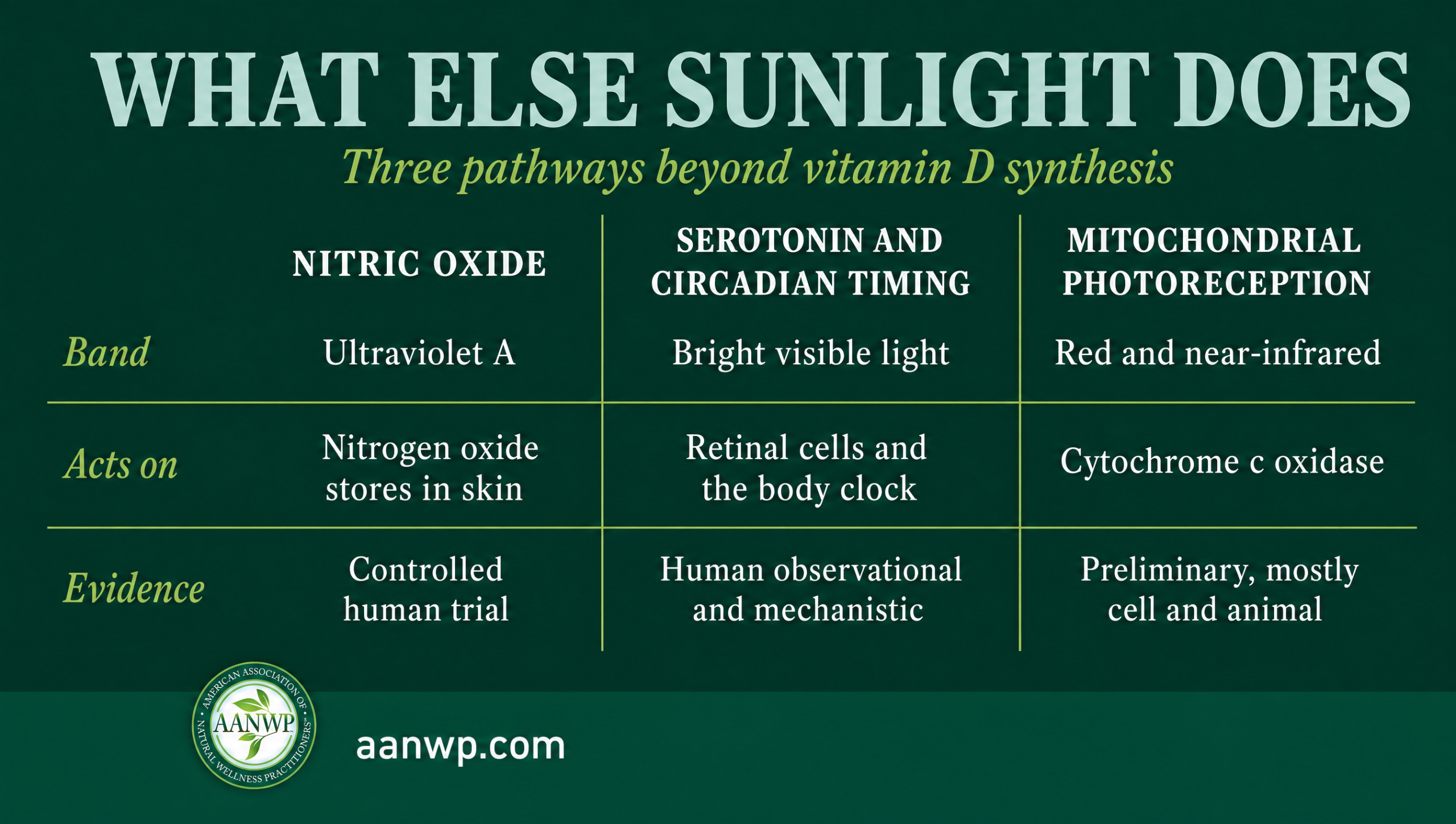
Sunlight affects the body through several pathways, and vitamin D is only one of them. Ultraviolet A releases nitric oxide from stores in the skin, which lowers blood pressure independently of vitamin D; bright light tracks with seasonal changes in brain serotonin turnover and sets circadian timing through the eye; and red and near-infrared light are absorbed by mitochondrial enzymes, though that third pathway remains preliminary. Because a serum 25-hydroxyvitamin D value records exposure as much as nutrient supply, supplementation raises the marker without reproducing the exposure. AANWP supports natural wellness practitioners who assess light exposure at this level of detail.
A lab printout sits on the desk in the second week of October. One line on it matters to the client sitting across from you, a serum 25-hydroxyvitamin D value flagged low, with a reference range printed beside it. The client has read enough to know the number is supposed to be higher, and has already asked what dose to take. It is a reasonable question and it has a reasonable answer, which is part of the problem. The answer arrives so quickly that the wider question never gets asked.
That number is worth having. It is also a narrow readout of something much wider. Serum 25-hydroxyvitamin D measures one product of one wavelength band acting on one molecule in the skin. Sunlight delivers a great deal more than that band, and the skin does a great deal more with it than make a vitamin. For a practitioner heading into the low-sun months, the useful question is not only how to raise a number. It is what else declines when light exposure declines, and how much of that a capsule does not replace.
What the Serum Value Actually Measures
Ultraviolet B, the narrow band between roughly 290 and 320 nanometers, strikes 7-dehydrocholesterol in the epidermis and converts it to previtamin D3, which then isomerizes under skin warmth to vitamin D3.


What the skin produces at that point is biologically inert. It requires hydroxylation in the liver to 25-hydroxyvitamin D, and a second hydroxylation in the kidney to the active hormone. The 25-hydroxy form is the one laboratories measure, because it circulates longer and reflects accumulated supply rather than momentary demand.
In a client who does not supplement, that value is as much a record of exposure as it is a measure of a nutrient. It tracks how much skin met how much ultraviolet B over the preceding weeks. This is why it falls predictably in winter, falls with increasing latitude, falls with age as the skin synthesizes less efficiently, falls in people with more melanin, and falls in people who spend their daylight hours indoors. It also falls in people who feel they are outside constantly, because window glass transmits ultraviolet A while blocking almost all ultraviolet B. A commute in bright light through a windshield produces no vitamin D at all. Supplementation raises the marker without reproducing the exposure that ordinarily produces it. That distinction is easy to lose, because a corrected number looks like a corrected situation. If ultraviolet B were the only thing sunlight did, the distinction would not matter. The rest of this piece is about why it does.
Nitric Oxide and the Skin as a Vascular Organ
Human skin holds substantial stores of nitrogen oxides. Nitrate, nitrite and nitrosothiols sit in the epidermis and dermal vasculature at concentrations well above those circulating in blood. Ultraviolet A, the longer band that passes through cloud and through glass, releases nitric oxide from those stores by direct photolysis rather than through enzyme activity. Nitric oxide is a vasodilator, and the skin is a large enough organ that what it releases reaches the systemic circulation.
A 2014 study in the Journal of Investigative Dermatology tested this directly. Twenty-four healthy volunteers received skin irradiation with two standard erythemal doses of ultraviolet A. Blood pressure fell, circulating nitrate fell, and circulating nitrite rose, a pattern consistent with nitric oxide being mobilized out of skin stores. The researchers showed that the effect ran independently of nitric oxide synthase and independently of vitamin D, which rules out the two explanations a reader would reach for first.
The honest framing of that result matters as much as the result. This was an acute laboratory exposure in a small sample of healthy people, the fall in blood pressure was modest, and it did not persist indefinitely. The sham condition in that same study produced a small transient fall that the authors attributed to warmth alone, which is a useful reminder of how easily a reading moves. One mechanism study does not establish a clinical effect, and no practitioner should present it as one.
What it does establish is that vitamin D is not the only route by which sunlight reaches the cardiovascular system. The long-observed pattern in which blood pressure runs higher in winter and higher at greater distance from the equator has a candidate mechanism that supplementation does not touch. That is a different claim from saying sunlight lowers blood pressure, and the difference is the whole point.
Season, Light, and Serotonin Turnover
The mood limb rests on a cleaner piece of human work than most readers expect. In 2002, researchers sampling blood from the internal jugular vein in 101 healthy men were able to estimate serotonin turnover in the brain directly rather than inferring it from peripheral measures. They found that turnover was lowest in winter and that the rate of serotonin production tracked the prevailing duration of bright sunlight, rising with luminosity. The measure is unusual and the design is difficult to run, which is part of why the finding has held its place.
There is a second route worth separating from the first, because it involves the eye rather than the skin. Intrinsically photosensitive retinal ganglion cells respond to short-wavelength light and signal the suprachiasmatic nucleus, which sets circadian timing and with it sleep onset, the cortisol rhythm, and the timing of melatonin release. This pathway does not require ultraviolet at all, and it does not care about vitamin D.
The practical consequence is that indoor light and outdoor light are not the same input. A well-lit office runs at a few hundred lux. An overcast day outdoors runs in the thousands, and a clear day runs far above that. A client can spend an entire day in what feels like plenty of light and receive one or two percent of the signal that sets the clock. Timing carries information that total hours do not, and morning light does work that late-afternoon light does not.
None of this makes light a remedy for a mood disorder, and a natural wellness practitioner is not the person assessing one. What it does mean is that a client reporting flatter mood, later sleep onset and lower energy after moving their working life indoors is describing something with plausible physiology behind it. Taking that seriously as a finding rather than as a vague complaint is the difference between a thorough intake and a fast one.
Mitochondria, and How Firmly to Hold It
Cytochrome c oxidase, the terminal enzyme of the mitochondrial electron transport chain, carries copper and heme centers that absorb light in the red and near-infrared range, with a broad absorption band peaking near 830 nanometers. Roughly half the energy in sunlight reaching the ground sits in the infrared, and near-infrared penetrates tissue considerably further than visible or ultraviolet light does. Those two facts together are why the mitochondrial limb of this topic exists at all.
That much is settled photochemistry. What follows from it is not. Almost all of the evidence that light at these wavelengths changes mitochondrial output comes from isolated enzyme preparations, cultured cells, animal models, and clinical work using light-emitting devices at selected wavelengths and doses. Very little of it comes from ordinary sun exposure in living human beings, and the findings do not all point the same way. At least one study that scanned across the near-infrared range found that some wavelengths increased cytochrome c oxidase activity while others reduced it, which is not what a simple more-is-better model would predict.

So this limb gets held loosely. It is a plausible mechanism under active investigation, not an established effect of going outdoors. Saying so out loud is part of teaching the topic rather than a hedge appended to it. A practitioner who presents a cell-culture finding with the same confidence as a controlled human trial teaches the client to discount everything else they say, including the parts that are well supported.

What This Changes in the Intake
If the serum value is one readout of a wider exposure, the intake question widens with it. Asking whether a client gets outside produces almost no usable information. Asking what the day actually looks like produces a great deal: what time they first see daylight, whether that first light arrives through a window, how long they are outdoors and at which hours, how much skin is uncovered when they are, whether they have been at this latitude all year, and what the eight to twelve weeks before the blood draw looked like. Two clients with identical values can have arrived there by entirely different routes, and the route determines what is worth changing.
Skin tone belongs inside that reasoning rather than beside it. Greater melanin content absorbs more ultraviolet in the epidermis, so the same synthesis requires longer exposure. That is a statement about ultraviolet absorption, not a risk category, and it changes the exposure estimate a practitioner should be working from before anything else is considered.
None of this argues for more sun in the sense that gets people burned. It is worth being precise about why, because the relationship between ultraviolet exposure and skin cancer is not uniform across the diseases involved.
Melanoma risk tracks most strongly with intermittent intense exposure and with a history of sunburn, particularly sunburn in childhood. Basal cell and squamous cell carcinoma track more closely with cumulative lifetime exposure, which runs in the opposite direction. Any single sentence about dose dependence that does not carry that split is not more accurate than the belief it is meant to correct.
The population-level evidence is genuinely interesting and genuinely contested, and both halves should be taught together. A twenty-year follow-up of 29,518 women in southern Sweden reported that women who avoided sun exposure had shorter life expectancy than those with the most active exposure habits, by roughly 0.6 to 2.1 years, with the difference concentrated in cardiovascular deaths and in deaths that were neither cancer nor cardiovascular. It is an observational cohort with self-reported exposure, and it drew published objections in the same journal arguing that residual confounding, smoking in particular, could account for much of the effect. Both of those things are true at once. Holding them at once is what makes a practitioner worth listening to on the subject.
The unresolved question sits underneath all of it. The National Institutes of Health Office of Dietary Supplements states plainly that no study has established a level of ultraviolet exposure that produces vitamin D without also carrying skin cancer risk. That is the honest shape of the topic, and a practitioner who says so is on firmer ground than one who resolves it in either direction.
What remains after all the caveats is unremarkable, and unremarkable is a compliment here. Regular short outdoor exposure, taken earlier in the day, well short of burning, is a different exposure pattern from two intense weeks in summer and nothing for the rest of the year, and the difference is visible in more than one of the mechanisms above. Where the light is not available, supplementation raises the marker, and it is worth telling the client exactly that: it raises the marker rather than replaces the light. Clients tend to trust the practitioner who draws that line more than the one who implies the capsule covers everything.
This kind of reasoning, holding a lab value, a mechanism and the strength of the evidence behind each one in view at the same time, is what separates a useful account of sunlight from a merely confident one. It is also what a client is choosing when they choose a practitioner over a search result. AANWP supports natural wellness practitioners earning non-exam board certification who read the evidence at this level before translating it into a recommendation.