
Heat, Cold, and Hormesis: What the Sauna Data Shows About Cardiovascular Outcomes
This article explains hormesis, the principle that a measured dose of stress can produce a protective response, and applies it to sauna and cold exposure. It walks through the Finnish cohort data linking more frequent sauna sessions with fewer fatal cardiovascular events, explains what observational data can and cannot prove, contrasts the thinner evidence for cold-water immersion, and outlines the screening a practitioner completes before recommending either, as published on the ANWPB blog.
The note is usually a single line in the lifestyle section of an intake form: sauna four evenings a week, cold plunge most mornings. In late October that line appears more often. Evenings turn dark and cold, a neighbor has put a barrel sauna in the backyard, the gym has added a plunge tub beside the locker room, and a podcast has made both sound like the most important habit a person can adopt for the heart. The practitioner reading that intake now has a question to answer, whether anyone asks it out loud or not: is this practice worth continuing, worth increasing, or worth pausing until something else is checked?
Answering well takes two kinds of knowledge that rarely arrive together. The first is the evidence itself, which is stronger for heat than most skeptics assume and thinner for cold than most enthusiasts admit. The second is the screening judgment that decides whether a practice with a good population record suits the particular person on that intake form. This piece works through both, starting with the principle that explains why a stressor might help at all.

Hormesis: Why a Measured Stress Can Build Capacity
Hormesis describes a dose-response pattern in which a small or moderate exposure to a stressor produces an adaptive, protective response, while a larger exposure to the same stressor produces harm. The idea is older than its name. Exercise is the familiar example. A demanding run strains muscle, heart, and metabolism, and over the following days the body responds by becoming better prepared for the next run. The same run done every day without recovery, or at an intensity far beyond current fitness, wears the body down instead.
Heat fits this pattern closely. A traditional Finnish sauna is hot and dry, commonly around 80 degrees Celsius, or roughly 175 degrees Fahrenheit. Within minutes, skin temperature climbs, blood vessels near the skin widen, heart rate rises toward the range seen in moderate exercise, and the body sweats heavily to shed heat. Cells respond to the thermal load by producing heat shock proteins, which help other proteins hold their shape under stress. Repeated over weeks, heat exposure is associated with adaptations such as expanded plasma volume and more responsive blood vessels, the same family of changes seen with regular aerobic training.
The useful word for a practitioner is window. A hormetic stressor helps inside a range set by intensity, duration, frequency, and recovery, and that range is not the same for every person. Someone whose cardiovascular system is already under strain has a narrower window, and for some people the window is closed for now. Hormesis therefore explains two things at once: why sauna bathing may benefit the heart, and why screening is part of the recommendation rather than an afterthought. Recovery belongs inside the window as well. The adaptive response happens after the exposure, during rest, rehydration, and sleep, so a schedule with no room for recovery turns a useful stressor back into a draining one.
What the Finnish Sauna Data Shows About Frequency
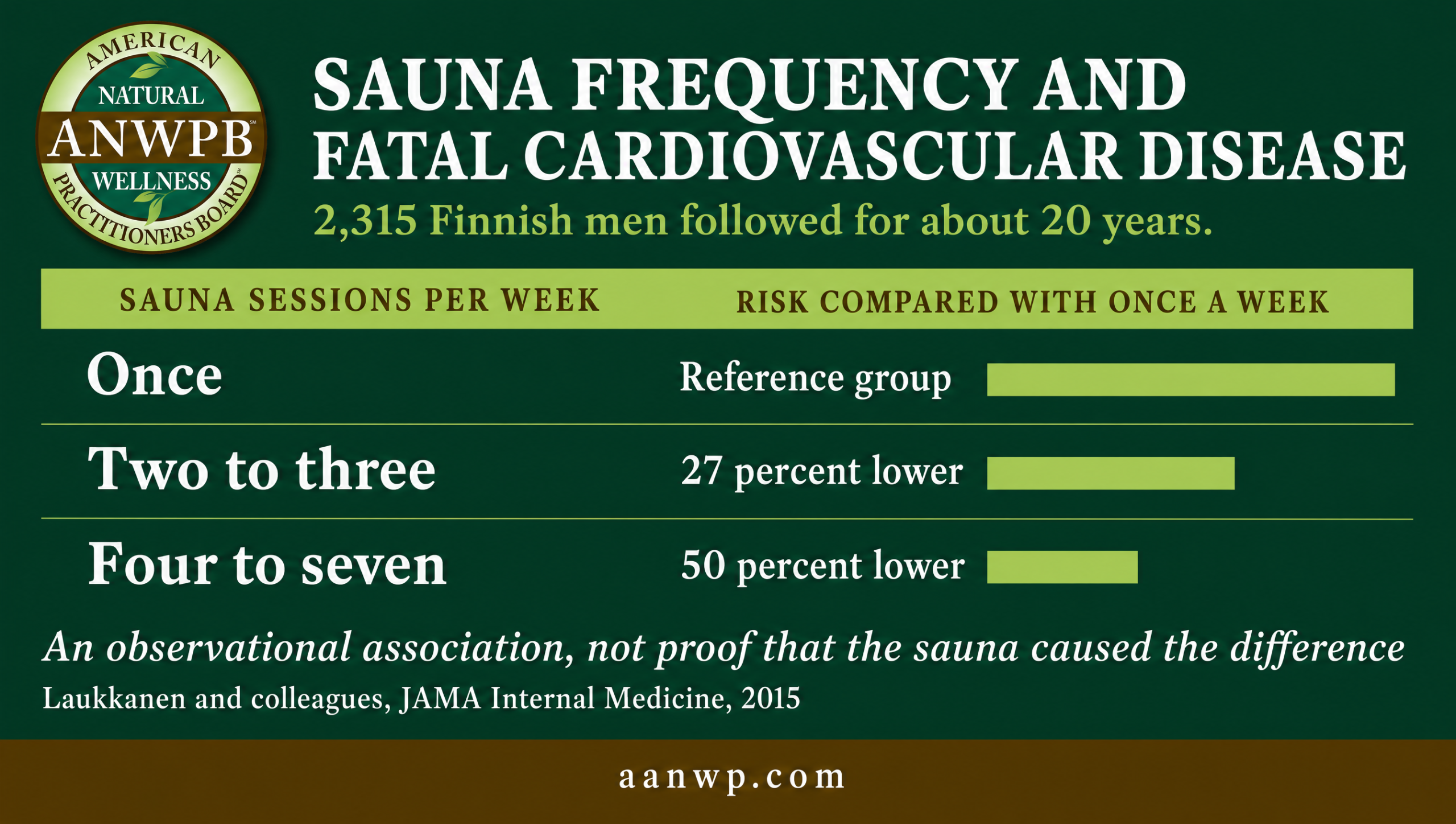
The most-cited evidence comes from the Kuopio Ischemic Heart Disease Risk Factor Study in eastern Finland, where sauna bathing is an ordinary weekly habit rather than a wellness trend. In 2015, Tanjaniina Laukkanen and colleagues reported on 2,315 middle-aged men followed for a median of about 20 years. The men, aged 42 to 60 at the start, described their sauna habits at a baseline examination between 1984 and 1989. Every man in the analysis used a sauna at least once a week, which gave the researchers an unusual comparison: frequency of use, rather than sauna users against non-users.
The pattern was graded. Compared with men who used the sauna once a week, men who used it two to three times a week had a 27 percent lower risk of fatal cardiovascular disease, and men who used it four to seven times a week had a 50 percent lower risk, after adjustment for age and conventional cardiovascular risk factors. The association with sudden cardiac death was stronger still, at 63 percent lower risk in the most frequent group. Session length mattered as well. Sessions longer than 19 minutes were associated with roughly half the risk of sudden cardiac death seen with sessions under 11 minutes. The average reported sauna temperature was about 79 degrees Celsius, or roughly 174 degrees Fahrenheit.
Two later reports from the same Finnish population widened the picture. A 2018 analysis in BMC Medicine followed 1,688 men and women aged 53 to 74 for a median of 15 years, and slightly more than half of that group were women. Four to seven sessions a week was again associated with substantially lower cardiovascular mortality than one session a week, and adding sauna frequency to conventional risk factors modestly improved the prediction of who would die of cardiovascular disease. A separate experiment from the same research group measured what one session does in the moment. In 102 adults with at least one cardiovascular risk factor, a single 30-minute session at 73 degrees Celsius lowered average systolic blood pressure from 137 to 130 mmHg and reduced pulse wave velocity, a measure of arterial stiffness, and systolic pressure remained below its starting level after 30 minutes of recovery.
What Cohort Data Can Establish, and What It Cannot
These findings are consistent, graded, and biologically plausible, which is why they deserve attention. They are also observational, which sets firm limits on what they can prove. A cohort study can show that frequent sauna users died of cardiovascular disease less often over two decades. It cannot show that the sauna caused the difference.
Several alternative explanations remain open. Men who were already unwell at baseline may have used the sauna less, which would make infrequent use look harmful when it was a marker of poor health; researchers call this reverse causation. Frequent sauna users may also have differed in ways the statistical adjustments did not fully capture, such as social connection, leisure time, stress, or income, a problem known as residual confounding. Sauna habits were reported once, at the start, and may have changed over twenty years. The BMC Medicine authors named these limits themselves. They noted that in their fully adjusted model the two-to-three-session group was no longer statistically different from the once-a-week group, and that the results come from traditional hot, dry Finnish saunas and may not apply to other settings.
That last point matters for the intake form. An infrared cabin at a lower air temperature, a steam room, and a backyard barrel sauna are not interchangeable exposures, and the cohort data describes only one of them. The figures are also relative. A 50 percent lower relative risk sounds dramatic, but the absolute difference depends on how common cardiovascular death is in the group being described, and it was measured in middle-aged and older Finns with their own diet, genetics, and health care.
A careful practitioner can say that regular sauna bathing is strongly associated with better cardiovascular outcomes in the best long-term data available, and that randomized trials on hard outcomes such as heart attack and death do not yet exist. Both halves of that sentence belong in the conversation.
Translating that into plain language for the person on the intake form takes practice. One honest version runs like this: in a large Finnish study, people who used a traditional sauna four or more times a week were about half as likely to die of heart disease over twenty years as people who went once a week, but the study could not prove the sauna was the reason, and it looked only at one kind of sauna in one population. That sentence neither dismisses the habit nor oversells it. It gives the person a fair picture of the evidence, leaves room for their own decision, and sets up the screening conversation that comes next, which is where the recommendation is made or held.
Cold Exposure: A Different Stressor With a Thinner Record
Cold plunges and winter swimming are often discussed as the natural partner of the sauna, and in Finland the two are frequently used together. The evidence, however, is not built the same way. There is no cold-water equivalent of the Kuopio cohort, with thousands of people followed for decades and cardiovascular deaths counted at the end. A 2022 review in the International Journal of Circumpolar Health by Didrik Esperland, Louis de Weerd, and James Mercer identified 104 relevant studies and found real physiological effects, including signs of improved insulin sensitivity and changes in body fat with repeated cold-water immersion. The authors also found that many of the studies were small, often included only one sex, and used different water temperatures, and they could not determine whether habitual winter swimmers were healthier to begin with. They described the health effects as a continuing subject of debate.
Cold is also a sharper stressor at the moment of entry. Sudden immersion in cold water triggers the cold shock response: an involuntary gasp, rapid breathing, and a steep rise in heart rate and blood pressure within the first minute or two. For a healthy, cold-adapted person, that response is brief and settles. For a person with high blood pressure that is not under control, or with a known heart rhythm problem, the same surge is exactly why caution is warranted. The hormetic window for cold appears narrower at the start, and the long-term outcome data that would justify a confident population-level claim is not yet available.


Screening Before Recommending Either
The dose-response data and the hormesis principle point to the same practical conclusion. The question is never simply whether sauna or cold exposure is good, but whether this exposure, at this dose, suits this person now. Screening is how a practitioner answers that question before recommending a practice that places real demands on the heart and blood vessels.
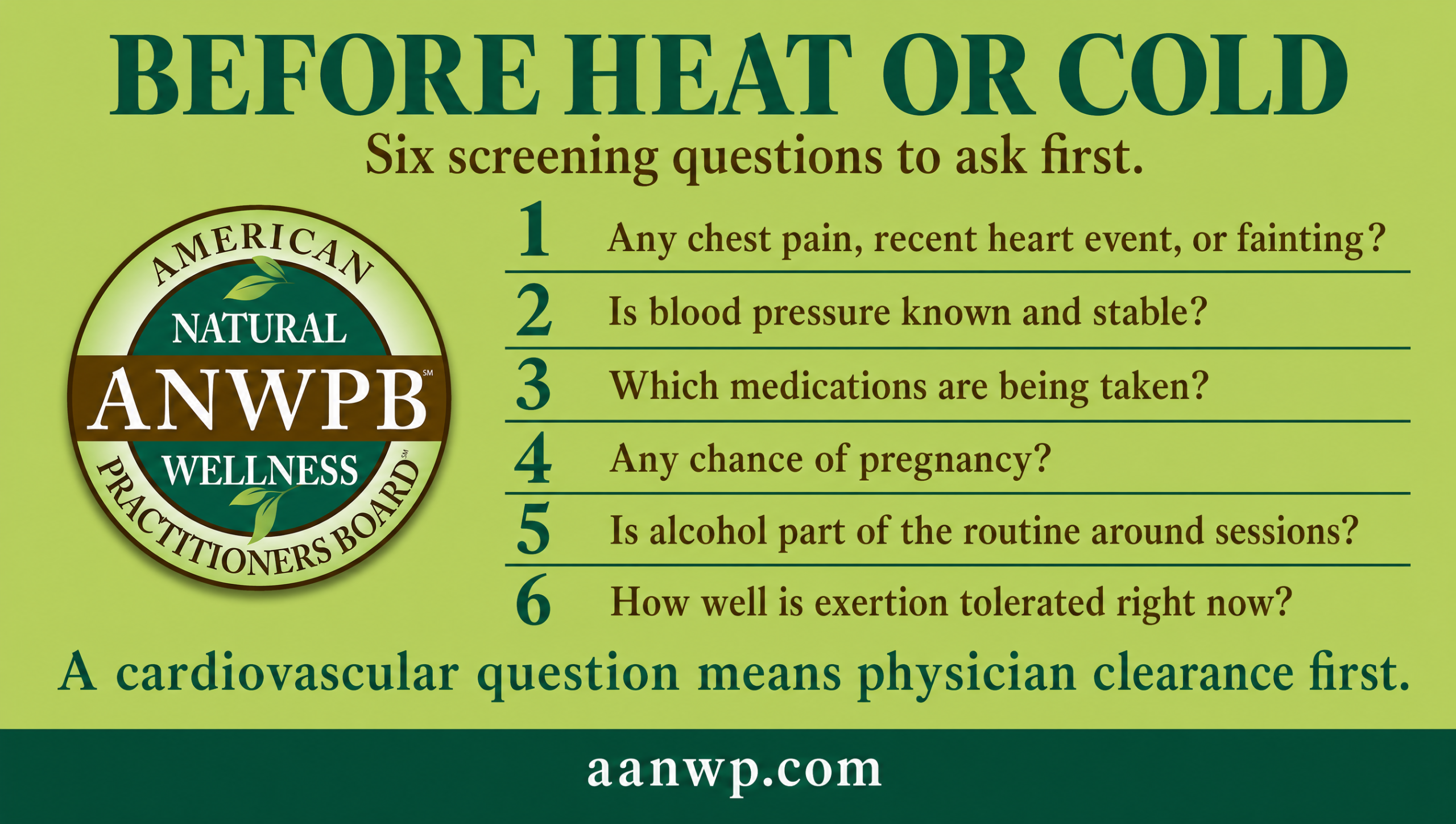
A thorough screen covers cardiovascular history, including chest pain, a recent heart event, a known valve or rhythm problem, fainting, or dizziness on standing. It asks whether blood pressure is known and stable. It reviews medications, since some blood pressure medications, diuretics, and other drugs change how the body handles heat, fluid loss, and sudden cold. It asks about pregnancy, about alcohol around sessions, which is a recurring factor in sauna-related harm, and about how well the person tolerates exertion right now. Any answer that raises a cardiovascular question is a reason to refer the person to their physician for clearance before beginning or increasing either practice, and that referral belongs in the client record.
For a person who screens clear, the evidence supports a gradual approach rather than an ambitious one. Heat can begin with shorter sessions at a comfortable temperature, with water before and after, a cool-down period, and no alcohol, building toward greater frequency over weeks if the experience stays comfortable. Cold, if the person wants to pursue it, begins with brief, controlled exposure such as the last thirty seconds of a shower turned cool, never alone in open water and never as a test of endurance. In late fall, when interest in both peaks, that kind of measured guidance is often the most valuable thing a practitioner offers: reading the research accurately, explaining what it can and cannot promise, and matching the dose to the person rather than to the headline.
Weighing dose against capacity, separating association from proof, and screening before recommending is clinical reasoning that holds up under examination, the kind that shows when the knowledge behind a recommendation has been tested rather than assumed. ANWPB supports natural wellness practitioners earning exam-based board certification who bring this evidence-literate judgment to every recommendation they make.