

The Inflammation Cascade: Where to Begin a Thorough Assessment
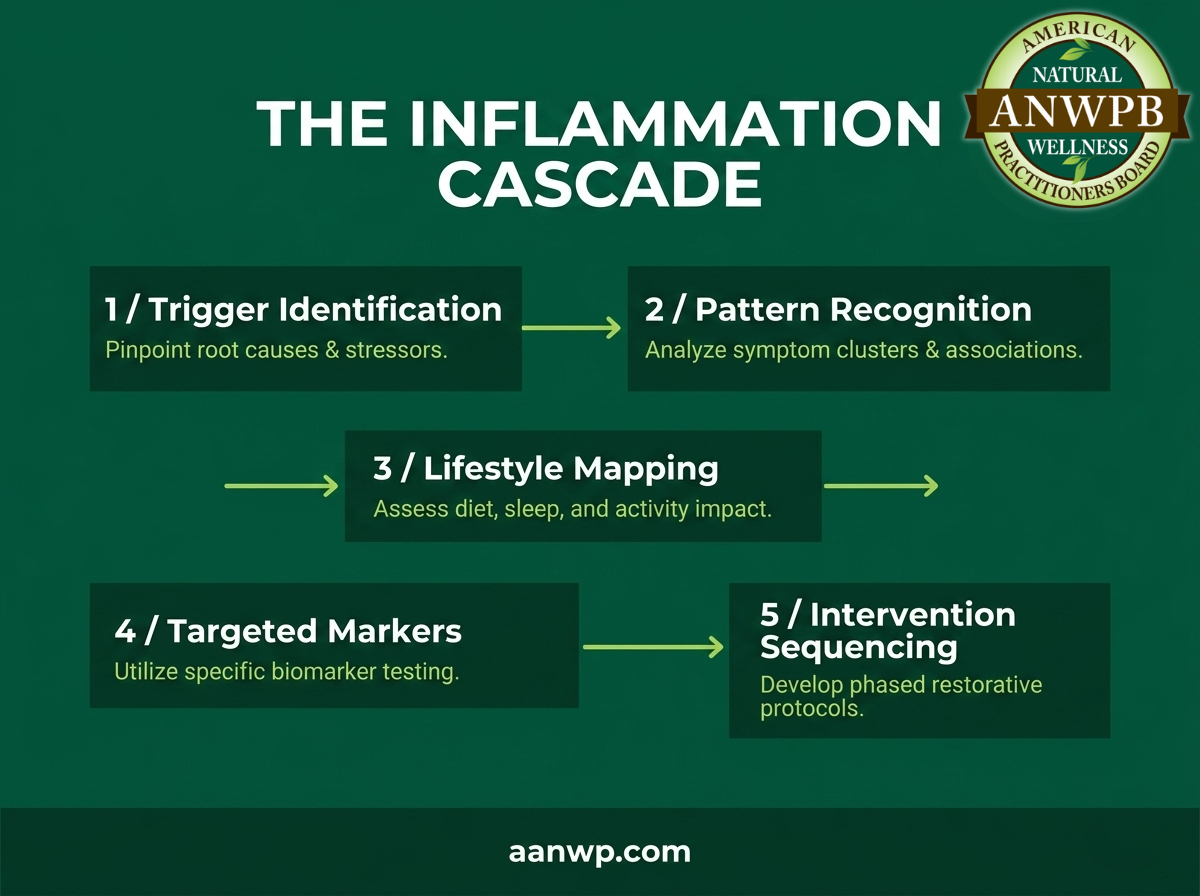
Chronic inflammation is best read as a pattern across sleep, glycemic load, gut barrier function, stress, and environmental inputs rather than a single lab value. A thorough assessment begins with detailed history and a seven-day input log before laboratory work, then reads markers like high-sensitivity C-reactive protein, fibrinogen, fasting insulin, and inflammatory cell ratios as a coherent story. ANWPB exam-based board certification verifies the clinical reasoning practitioners need to do this assessment work at depth.
The lab report sits open on the desk. C-reactive protein is flagged at 4.2 milligrams per liter, just above the standard reference cutoff but not high enough to signal acute infection. Fatigue, mild joint stiffness, an irritability the client describes as new. The numbers say something is happening. The numbers do not say what.
This is the moment chronic inflammation reveals itself as a root-cause concept rather than a number on a page. A single elevated marker does not name the driver. It signals that a pattern is in motion somewhere in the body and that the assessment from here forward asks a different question: what is feeding this signal, and where is the upstream input?
For the natural wellness practitioner trained to look beyond the lab cutoff and into the lived life of the client, the inflammation cascade is one of the most useful organizing concepts available. It connects sleep, glycemic patterns, gut function, stress physiology, and environmental load into a single physiological story. It also asks the practitioner to assess in layers, not flags.

What Practitioners Mean by Root-Cause Inflammation
Acute inflammation is the body’s emergency response: a cut, an infection, a sprained ankle. Cytokines rise sharply, immune cells flood the site, the tissue heals, and the response resolves in days to weeks. The system is doing exactly what it was designed to do.
Chronic low-grade inflammation operates differently. It is the steady, smoldering production of inflammatory mediators across weeks, months, and years, often below the threshold of overt clinical disease. The cytokines stay slightly elevated. Immune signaling remains active. Tissues that are not injured continue to receive low-level inflammatory messaging.
This persistent state has a recognized physiological signature. Circulating levels of interleukin-6, tumor necrosis factor alpha, and high-sensitivity C-reactive protein sit elevated above optimal but often within the broad reference range used for acute disease screening. The reference range was built to catch infection. It was not built to identify the slow burn.
Three features distinguish the chronic state from the acute. The first is duration: the response does not resolve. The second is amplitude: levels stay modestly elevated rather than spiking. The third is the organ systems involved. Chronic inflammation is rarely confined to one tissue. Endothelium, adipose tissue, gut mucosa, neural tissue, and joint synovium all participate in low-grade inflammatory signaling, and each can both source and receive the mediators that keep the cascade in motion.
This is why a single laboratory value can mislead. A C-reactive protein reading of 3.8 milligrams per liter sits in a clinical zone where the conventional report flags it but the conventional encounter offers no next step. For the practitioner reading the same number with the cascade in view, that value is the entry point to a longer conversation: what tissue is producing this signal, what input is sustaining it, and which lifestyle, dietary, or environmental driver is the most accessible to address first.
Five Drivers Worth Mapping First
The chronic inflammatory cascade has many possible upstream inputs. Five drivers cover most of what the working practitioner sees in a typical client load, and each is assessable through history, lifestyle review, and targeted laboratory work.
Sleep architecture and circadian disruption come first because sleep loss is one of the most reliably inflammatory inputs in the literature. Even one night of restricted sleep elevates inflammatory cytokine production measurably the following day. Chronic short sleep, irregular sleep timing, and disrupted circadian rhythm produce sustained low-grade elevation. The intake conversation here is detailed: total hours, sleep timing consistency, light exposure across the day, and the presence of waking events that fragment the sleep period.
Glycemic patterns and metabolic load follow closely. Sustained postprandial glucose excursions, insulin resistance, and elevated visceral adiposity all sit upstream of inflammatory signaling. Adipose tissue itself is an active producer of inflammatory cytokines, and the metabolic state of the cell determines how much signaling it sends. A continuous glucose monitor trial, a basic metabolic panel with insulin and HbA1c, and a careful dietary review begin to map this driver.
Gut barrier function is the third driver and perhaps the most often missed in the conventional encounter. Increased intestinal permeability allows lipopolysaccharide and other bacterial components to reach systemic circulation in quantities sufficient to activate the innate immune response. The body responds by maintaining low-level inflammation as long as the input continues. Reviews of intestinal permeability and chronic disease have linked compromised gut barrier function to a wide range of inflammatory conditions. Assessment includes symptom mapping, dietary review for known disruptors, and where appropriate, laboratory markers of intestinal permeability and dysbiosis.
Chronic stress load and HPA-axis dysregulation contribute through cortisol’s complex relationship with inflammation. Acute cortisol suppresses inflammatory signaling. Chronically elevated or dysregulated cortisol patterns lose that suppressive effect and in some cases amplify it. Salivary cortisol patterns across the day, perceived stress measures, and sleep quality together begin to outline this driver.
Environmental load is the fifth, and it covers a wide territory: food sensitivities producing low-grade immune activation, exposure to environmental toxins, chronic indoor air quality issues, and in some clients, mold exposure. The driver is rarely singular. The assessment is thorough environmental history-taking combined with selective laboratory work where the history points clearly.

Markers Worth Reading as a Pattern
Once the upstream drivers are mapped through history and lifestyle review, laboratory work can sharpen the picture. The principle that governs this stage of the assessment is straightforward: a single inflammatory marker tells a practitioner very little. A pattern of markers tells a story.
High-sensitivity C-reactive protein is the most familiar marker and the most useful entry point. Optimal values typically sit below 1.0 milligram per liter. Values between 1.0 and 3.0 milligrams per liter raise the question of low-grade inflammation. Values above 3.0 milligrams per liter without acute illness signal a sustained inflammatory state that warrants thorough evaluation. The marker on its own does not name the driver, but its trajectory across two or three measurements often signals whether interventions are working.
Fibrinogen, erythrocyte sedimentation rate, and ferritin add depth.
Fibrinogen reflects acute-phase protein synthesis and tracks with inflammatory load over time. Erythrocyte sedimentation rate, while less sensitive, picks up inflammation that high-sensitivity C-reactive protein occasionally misses. Ferritin functions as both an iron storage marker and an acute-phase reactant, and elevation in the absence of iron overload often signals inflammation.
Glycemic markers belong in any thorough inflammation panel. Fasting insulin, fasting glucose, HbA1c, and the homeostasis model assessment of insulin resistance together describe metabolic inflammatory load far more accurately than any single value. A client with a normal glucose and an elevated fasting insulin is showing the early metabolic signature of inflammatory drive.
Inflammatory cell ratios drawn from a complete blood count add nuance. The neutrophil-to-lymphocyte ratio and the monocyte-to-lymphocyte ratio have accumulating research support as accessible markers of systemic inflammatory load using data already collected in routine bloodwork.
The order matters. Reading any one of these as a flag in isolation invites the same trap as a single reference range cutoff. Reading them as a pattern, with the client’s history and lifestyle alongside, is the work the practitioner is uniquely positioned to do. The clinical reasoning required to read markers as a pattern sits at the heart of ANWPB Naturopathy and Natural Medicine board certification.
Where the Thorough Assessment Actually Begins
The temptation in inflammation work is to begin with laboratory orders. The work usually begins earlier, in the intake conversation.
A thorough first session for a client with suspected chronic inflammation extends well beyond the standard medical history. Sleep timing and quality across a typical week. Stress sources, current and recent. Dietary patterns including not only what but when, how often, and in what social context food is consumed. Movement patterns. Environmental exposures including living and working environments. Family history of inflammatory and autoimmune conditions. Medication and supplement history. Past responses to dietary or lifestyle interventions.
The conversation is long because inflammation rarely arises from one input.

Mapping the lived life of the client reveals which drivers are present and which are most accessible to begin addressing. Working within ANWPB scope of practice guidelines keeps the assessment grounded in lifestyle, dietary, and educational territory rather than diagnosis or treatment.
The seven-day input log follows. The client tracks food, sleep, stress, movement, and any noted symptoms across one full week. The log is not a research instrument; it is an observational tool that often reveals patterns invisible to recall alone. Weekend sleep that compensates for weekday short sleep. Stress eating that follows specific work events. Symptoms that cluster around particular foods or times of day.
Body-system review through a thorough symptom inventory comes alongside the log. The ANWPB practitioner trained in clinical reasoning is reviewing here for patterns: digestive symptoms suggesting gut barrier involvement, sleep markers suggesting circadian disruption, mood symptoms suggesting stress load.
Laboratory work follows the conversation rather than precedes it. The history identifies which drivers warrant evaluation, and the labs are selected to test those hypotheses. A client whose history points to gut and dietary drivers receives a different panel from one whose history points primarily to stress and sleep. This is the difference between sequential assessment and the reflexive ordering of a generic inflammation panel.

A Framework for the First Three Sessions
The first session is for pattern recognition. The thorough intake, the seven-day log assignment, and the symptom inventory create the working hypothesis. The client leaves with the log, a reading list relevant to the suspected drivers, and one small foundational habit to practice across the week. No interventions are layered on yet. The practitioner needs the data the log will return.
The second session reviews the log alongside the targeted laboratory work, refines the hypothesis, and introduces the first tier of interventions. These are typically the highest-leverage, lowest-friction changes the history pointed to: shifting the timing of evening light exposure for the client whose sleep is fragmented, removing the most clearly suspected food triggers for the gut-driven client, adding morning movement for the stress-driven client. One driver, two or three intervention points.
The third session re-assesses. Has the symptom log shifted? Are sleep, energy, digestion, or mood reporting different? If laboratory work was repeated at this point, do the markers reflect the felt change? The third session is where the practitioner refines or re-directs based on what the body has shown in response to the first interventions.
This is what depth assessment of chronic inflammation looks like in actual practice. It is patient. It builds on history and lifestyle review before it builds on laboratory work. It treats the markers as information about a pattern rather than as targets in themselves. It is the kind of work the practitioner trained in natural wellness is uniquely positioned to do.
The single elevated value on the lab report does not tell the story. The practitioner who has trained in inflammation as a root-cause concept reads that value as the opening of a longer conversation, one that reaches into sleep, glycemic patterns, gut function, stress, and environmental load. The thorough assessment is the work; the markers are the punctuation.
ANWPB supports natural wellness practitioners earning exam-based board certification who do root-cause thinking like this.