The Documentation Framework Every Natural Health Practitioner Needs
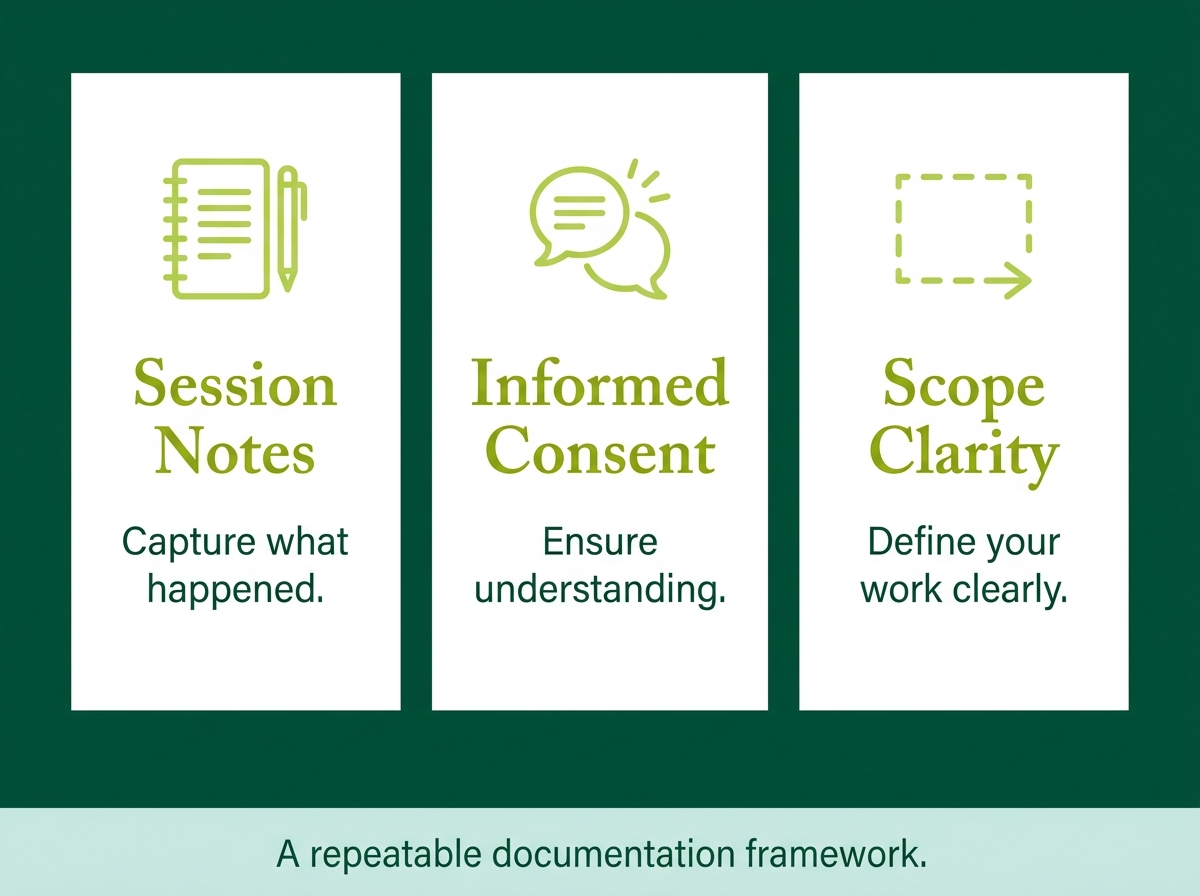
Good documentation is care, not bureaucracy. A simple framework gives a natural health practitioner a repeatable way to capture what matters: clear session notes built on four plain parts (what the client reports, what you observe, your assessment, and the plan), informed consent approached as an honest conversation rather than just a signature, and scope clarity about what the work includes and where it ends. Made into a small, consistent habit, this framework serves both the practitioner and the client and reflects a practitioner who takes the whole of their work seriously.
Most natural health practitioners do not set out to keep poor records. They set out to help people, and the notes get written in the margins of a busy day, if they get written at all. A line scribbled on a card here, a detail held in memory there, a consent conversation that happened out loud and was never written down anywhere. It works, right up until the moment it does not.
The moment usually arrives quietly. A client returns after four months and refers to something you agreed last time, and you cannot quite remember the details. A new client asks what exactly your sessions involve, and your answer comes out slightly different from the way you described it to the last person. Someone asks, gently or otherwise, what you actually said about what you do and do not offer. None of these is a catastrophe on its own. All of them are easier to handle when there is a clear record, and a good deal harder when there is not.

A documentation framework is simply a repeatable way of capturing what matters: what happened in a session, what the client agreed to, and what falls inside and outside the work you offer. Done well, it does not feel legalistic at all. It feels like the quiet confidence of a practitioner who knows exactly where they stand, and who never has to scramble to reconstruct it.
Why Documentation Is Care, Not Bureaucracy
There is a reason good documentation tends to be associated with paperwork and dread. Most people meet it first as a compliance demand, a box to tick rather than a practice to value. That framing does it a real disservice, because documentation, at its best, is a form of care.
For the client, a good record means continuity. The person who sees you in March is met by someone who remembers what mattered in January, who can track how things have actually changed, and who does not ask them to retell their whole story every visit. That continuity is part of what people are paying for, even though they never name it directly. For the practitioner, a record is memory you can trust. It is a way of seeing patterns across sessions that the mind alone tends to blur, and a quiet reassurance if anyone ever asks what was discussed or agreed.
Once you see documentation as care rather than bureaucracy, the goal shifts. You are not building a defensive paper trail to survive a worst case. You are building a clear, honest account of your work that serves the people in front of you and the practitioner you are becoming. That is a far better reason to keep good notes, and a far more sustainable one, because it connects the habit to the part of the work you already care about.
A Simple Framework for Session Notes
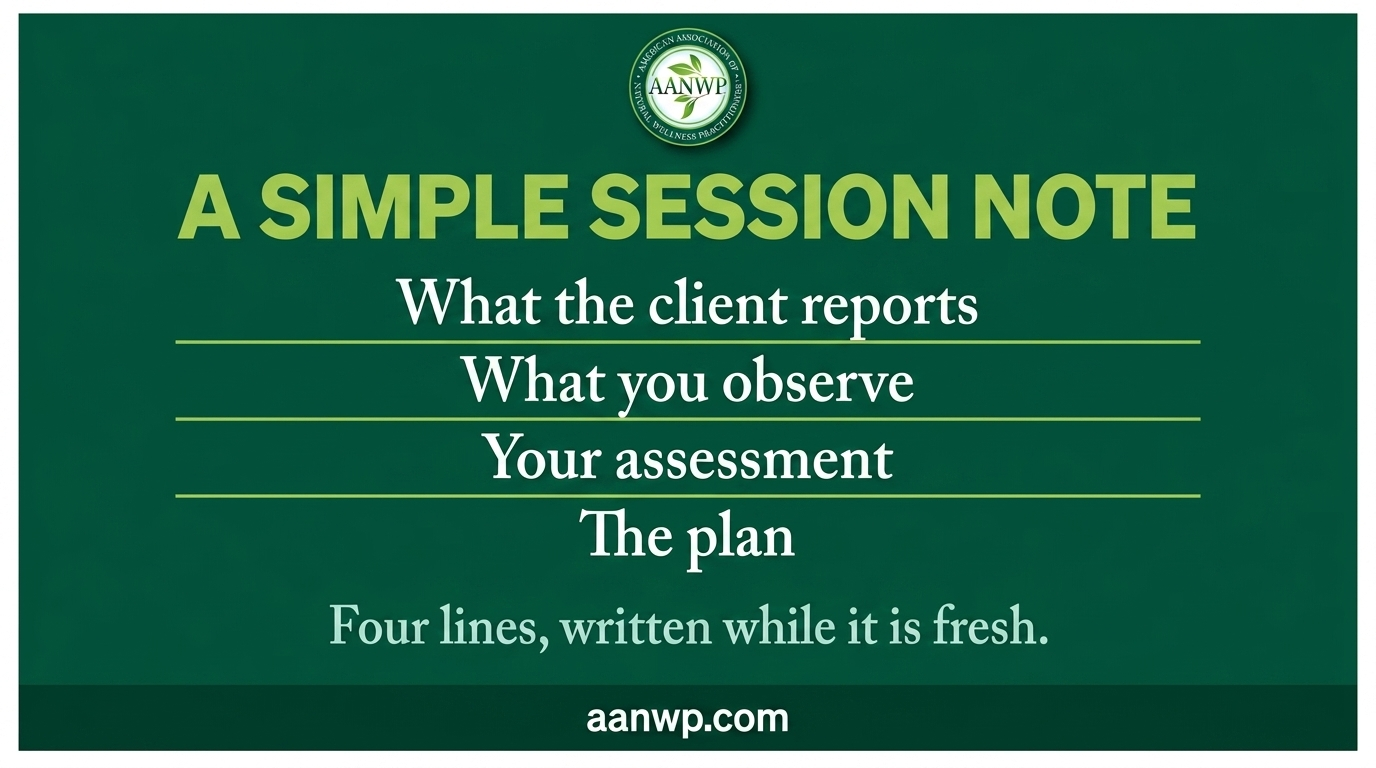
The most durable documentation framework in the helping professions is also one of the simplest. The widely used SOAP note method, developed in clinical settings decades ago, organizes a session note into four plain parts, and it adapts cleanly to natural health work without any need to borrow clinical language.
The first part is what the client reports: how they say they are doing, in their own words, including what has changed since you last met. The second is what you observe: the things you notice during the session that are worth recording. The third is your assessment, meaning your read of the situation, the patterns you are starting to see, and the questions you still have open. The fourth is the plan: what you and the client agreed to focus on next, any suggestions you offered, and what the client intends to do before you meet again.

Here is what that can look like in practice. A returning client comes in tired and discouraged. Under what the client reports, you note that they describe low energy in the afternoons and trouble staying with the routine you discussed last time. Under what you observe, you note that they seem flat but engaged, and that they mention skipped meals more than once. Under your assessment, you note a likely link between the skipped meals and the afternoon slump, along with a question about how realistic the earlier routine really was. Under the plan, you note that you agreed together to simplify the routine to two changes and to revisit it in three weeks. Five lines, and a complete, honest picture of the session that you can pick up cold a month later and understand immediately.
Four parts, a few lines each. The point is not length. A useful note is short, specific, and written while the session is fresh, ideally in the few minutes right after the client leaves. What makes it powerful is consistency. A practitioner who captures those four things every time builds, session by session, a record that tells the real story of a person’s progress, in a form any future version of themselves can read at a glance.
Informed Consent as a Conversation, Not a Form
Informed consent has a reputation as a signature on a page, but the principle behind it is really about communication, not paperwork. At its heart, informed consent means the client genuinely understands what they are agreeing to before they agree to it.
For a natural health practitioner, that conversation has a few honest parts. What your sessions actually involve. What the client can reasonably expect from the work, and what they should not expect. The plain fact that your work supports wellbeing and does not replace medical care. And the simple acknowledgment that the client is choosing to work with you on those terms, freely and with a clear picture of what the work is and is not.
It also helps to be specific about the things people most often misunderstand. Many clients arrive quietly assuming that any practitioner who works with health is, in some loose sense, a stand-in for their doctor. A clear consent conversation corrects that gently at the very start, so the relationship begins on accurate footing rather than on an assumption that could disappoint, or even harm, much later.
The written piece matters, but it follows the conversation rather than replacing it. A short, plain-language consent document that the client reads and signs is worth far more than a dense form nobody understands.

It records that the conversation happened and what was agreed, and it honors the client’s right to make an informed choice about their own care. When consent is approached as a genuine exchange rather than a hurdle to clear, clients trust the work more, not less, because the honesty is obvious from the very first session.
Scope Clarity: Saying What You Do, and Where It Ends
The third piece of the framework is the one practitioners most often leave implicit, and it causes the most trouble when it is missing. Scope clarity means being able to say, plainly and consistently, what your work includes and where it ends.
This is not about diminishing what you do. It is about defining it. A natural health practitioner who can describe their work clearly, the kind of support they offer, the questions they help people think through, the lifestyle and wellbeing territory they genuinely work in, is far easier to trust than one who is vague or who quietly implies they can address anything at all. Clarity about the edges is part of professionalism. It tells a client exactly what they are getting, and it tells them, just as importantly, what they are not.
Consider two practitioners facing the same moment. A client asks one of them to weigh in on a prescription their doctor has them on. The vague practitioner, wanting to be helpful, offers an opinion anyway. The clear practitioner names it simply as outside their work and returns the conversation to the lifestyle and wellbeing support that is genuinely theirs to give. The second has not been less helpful. They have been more trustworthy, and a good deal safer for the client.
Documented consistently, in your notes and in your consent conversation, that clarity becomes a stable line you can stand on, rather than a judgment you have to improvise under pressure. Knowing the edge of your work, and being willing to name it out loud, is not a limitation on your practice. It is one of the clearest signs that you take the practice seriously. Clients feel that steadiness even when they could not name it. A practitioner who is sure of their own edges puts people at ease, because there is no quiet worry in the room that the work might wander somewhere it was never meant to go.
Making the Framework a Habit
A framework that lives in a drawer helps no one. The practitioners who actually keep good records are not more disciplined than everyone else. They have simply made the framework small enough to sustain.
That usually comes down to three things. A template you do not have to reinvent each time, so the four parts of a session note are already waiting for you to fill in. A fixed moment to do it, most often the few minutes right after a client leaves, while the detail is still sharp. And a standard you can actually live with: consistency over perfection. A short, honest note written every time beats a beautiful one written occasionally, and a framework you follow ninety percent of the time is worth far more than an ideal you abandon by the second week. If even that feels like a lot at first, start with one client or one part of the day, prove to yourself that the few minutes are sustainable, and let the habit widen from there.
The aim is not to become an administrator. It is to make the record-keeping so routine that it stops competing with the work and starts supporting it. When the framework is a habit, documentation, consent, and scope stop being things you worry about in the back of your mind and become things you simply do, the same way you tidy the room before the next client arrives.
None of this requires a law degree or a filing cabinet full of forms. It requires a simple, repeatable framework and the decision to use it: clear session notes, an honest consent conversation, and a plain account of what your work is and is not. Practitioners who build those habits do not only protect themselves and their clients. They carry themselves differently, with the steadiness of someone who knows exactly what they offer and can show it without hesitation.
That steadiness is part of what board certification is meant to recognize and support: not paperwork for its own sake, but the mark of a practitioner who takes the whole of their work seriously.
AANWP supports natural wellness practitioners earning non-exam board certification who hold themselves to this kind of clarity.