
Earning the Referral: How Natural Health Practitioners Build Trust With Conventional Providers
Natural health practitioners earn referrals from conventional providers by understanding the provider’s caution, which is rooted in liability and evidence, and by writing for that reader. A strong referral note is short: it states your role and scope, why you are writing, the supplements and amounts so interactions can be checked, and your deferral to the provider on diagnosis and medication. Clear language about what you do and do not do earns respect, and referrals accumulate through repeated, bounded, reliable communication over time. ANWPB supports natural wellness practitioners earning exam-based board certification.
A client mentions, almost in passing, that she is seeing a cardiologist next week. She has been working with you on stress, sleep, and a handful of supplements, and now the two worlds are about to meet. There is a version of this moment that goes badly, where the physician hears the word supplements and stops listening, and the client is left translating between two professionals who do not speak to each other. There is also a version that goes well, where the physician reads a short, clear note from you, understands exactly what you are and are not doing, and files you away as a practitioner worth coordinating with. The difference between those two outcomes is rarely the quality of your work. It is the way you communicate it.
For a natural health practitioner, the conventional provider is not an obstacle to work around. They are a colleague who happens to speak a different professional language, hold a different set of concerns, and carry a different kind of liability.

Earning a referral, or even earning the quiet respect that keeps a physician from steering a client away from you, is a skill worth building deliberately. It rests on understanding how the provider thinks, writing for that reader rather than for your client, and being scrupulously clear about the edges of your own scope.
Why Conventional Providers Are Wary
It helps to start with an honest picture of the physician’s frame, because much of what reads as hostility is really caution shaped by their training and their exposure. A conventional provider has spent years inside a system organized around diagnosis, evidence, and accountability. They are responsible, legally and professionally, for what happens to the patient, and that responsibility makes them conservative about anything they cannot verify. When a patient says they are taking something a practitioner suggested, the physician’s first question is not whether you are a fraud. It is whether they know what this is, whether it interacts with what they have prescribed, and whether they are now accountable for a variable they did not choose.
Many providers have also been burned, usually by the exceptions rather than the careful majority of the field. They have seen a patient put off care they genuinely needed because a natural approach was framed as a replacement for it, or heard confident promises that did not hold up. That history is not fair to the conscientious practitioner, but it is the water you are swimming in.

The practitioner who understands this does not take the wariness personally. They regard it as information about what the provider needs in order to relax, which is almost always the same short list: clarity about what you do, assurance that you are not interfering with the medical care, and evidence that you know where your lane ends.
One concern sits above the others, and naming it directly earns immediate credit: interactions. A physician calculating a medication dose needs to know what else is in the patient’s system, and a supplement the patient never mentions is exactly the unknown that keeps providers cautious. The practitioner who proactively lists what a shared client is taking, with amounts, and points the provider toward the relevant interaction data, has just done the provider a favor rather than handing them a problem. That single act, offering the interaction picture before being asked, reframes you from a risk into a resource.
Write for the Provider, Not the Client
The single most useful habit is to write any communication to a physician as if the physician, not your client, is the only reader who matters, because they are. Your client already trusts you; the note is not for them. The provider is busy, skeptical by default, and deciding within about thirty seconds whether to keep reading. That means the note is short. It names who you are and what you do in one line, states what you have observed in plain measurable terms, describes what you have suggested without dressing it up, and makes a specific request if you have one. A page of philosophy about root causes will lose them. Three tight sentences that respect their time will not.
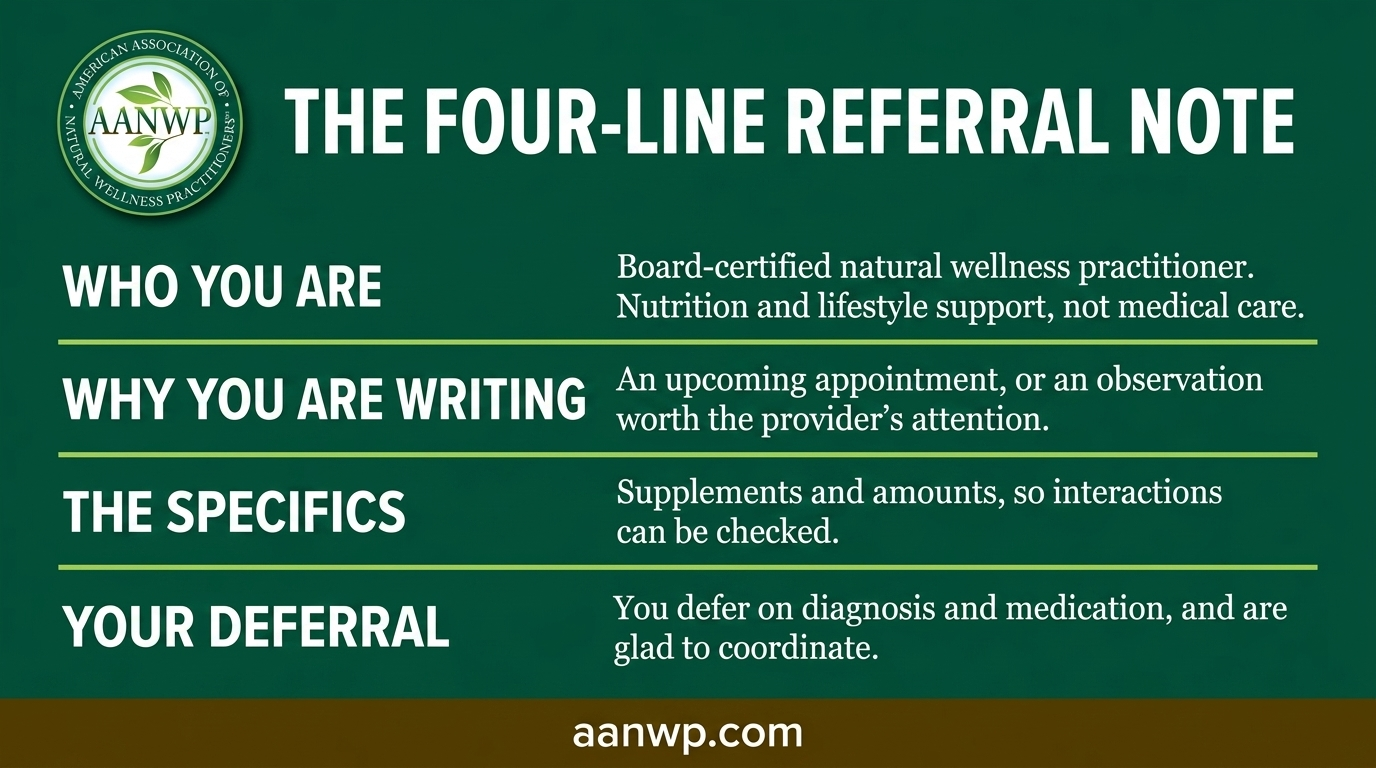
Concretely, a strong referral note has a predictable shape. The first line gives your role and scope, for example that you are a board-certified natural wellness practitioner providing nutrition and lifestyle support, not medical care. The second says what prompted the note, whether the client mentioned an upcoming appointment or you noticed something worth the provider’s attention. The third gives the specifics: the supplements the client is taking, with amounts, so the provider can check for interactions, along with any lifestyle changes that might move a reading or a lab value. The fourth states your request or your deferral, making clear that you defer entirely to the provider on diagnosis and medication and that you are glad to coordinate. The whole thing fits on a note card, and its brevity is the point. A physician who can absorb your entire message in fifteen seconds is a physician who will read the next one.
The contrast is easy to feel once you see it. A weak note rambles: it opens with the practitioner’s philosophy, walks through the client’s entire history, and buries the one fact the provider needed under three paragraphs of context. A strong note leads with that fact. Compare a line like, I have been working holistically with your patient to rebalance her system and restore vitality, against, Your patient is taking magnesium glycinate at 300 milligrams nightly and vitamin D at 2000 units daily, and I wanted you to have that before her appointment. The first tells the provider nothing they can act on and hints at someone who may not know their own limits. The second hands them a usable fact and signals a practitioner who understands what the moment requires. Writing the second kind of sentence is a learnable habit, and it is the habit that gets you read.
Language That Earns Respect
The words you choose carry more weight than you might expect, because they signal whether you understand the boundaries of your work. The practitioner who writes that they are supporting a client’s energy and digestion through targeted nutrition sounds like a colleague. The one who writes that they are addressing the client’s thyroid condition sounds like someone practicing medicine without the training to do so, and a provider will react to that phrasing the way you would react to a stranger giving confident advice in your own field. Naming what you do in the language of support, education, and lifestyle, and naming clearly what you do not do, is what separates a practitioner a physician can work with from one they feel obligated to correct.
Being explicit about your scope is not a weakness to hide. It is the strongest card you hold. A sentence as plain as, I do not diagnose or prescribe, and I defer to you on all medical questions, does an enormous amount of work. It tells the provider you know your lane, it removes the threat they were bracing for, and it frees them to see you as an addition rather than a risk.
This is also where sound documentation and a clear scope-of-practice foundation pay off, because the confidence to state your limits plainly comes from having thought them through in advance. Practitioners sometimes worry that stating limits makes them look small. The opposite is true. Nothing signals professional maturity to a physician faster than someone who names the edge of their scope without being asked.
There is also a discipline in how you describe outcomes. Conventional providers are trained to distrust promises, so a practitioner who claims a supplement fixed a client’s fatigue invites doubt, while one who reports that the client describes better energy and more consistent sleep since adjusting an evening routine offers an observation the provider can actually weigh. Speaking in observations rather than conclusions, and in the client’s reported experience rather than in cures, keeps you on the credible side of the line. It also mirrors the same care with evidence that the provider was trained to expect, which is a quiet way of signaling that you and they are playing by compatible rules.

Building the Relationship Over Time
A single well-written note rarely produces a referral on its own. What it produces is a first impression that you are safe to deal with, and referrals grow from a series of those. The practitioner who sends a clear update after a shared client’s appointment, who never oversteps, and who occasionally passes along a genuinely useful and well-sourced piece of information becomes, over months, a known quantity. Physicians refer to people they trust, and the trust that encourages open disclosure is built the slow way, through repeated small proofs that you are competent, bounded, and easy to coordinate with.
It also helps to remember that you are not trying to convert anyone. The goal is not to win an argument about the merits of natural health. It is to become a practitioner the provider is comfortable having in a client’s life. Some physicians will warm quickly, others will stay politely distant, and a few will never come around, and none of that is a verdict on your work. The practitioners who build real collaborative relationships are the ones who play the long game with equanimity, who keep their communication clean and their scope clear, and who let a track record accumulate rather than forcing the point.
Small logistics matter more than they seem. Ask the client how their provider prefers to receive information, since some want a note the client carries in by hand and others will accept a fax or a portal message, and sending through the channel the provider already uses signals that you respect their systems. Keep a copy of what you send in your own records, both because clean documentation protects you and because a provider who later has a question can be answered in minutes rather than left guessing. And time the note to arrive before the appointment rather than after, so the provider walks in already holding the context instead of discovering it secondhand. None of this is complicated, but attending to it is part of what marks a practitioner as easy to work with.

This is also, quietly, a matter of what the profession looks like from the outside. Every natural health practitioner who communicates well with a physician makes the next practitioner’s introduction a little easier, and every one who oversteps makes it harder. Choosing to be the practitioner who earns respect is a contribution to a body of colleagues working to be taken seriously, not just a personal advantage. It is the kind of standard a serious practitioner holds because of who they want to be counted among, and it is one of the ways this field grows up.
Communicating with conventional providers at this level, with clarity about scope, discipline about language, and patience about the relationship, is exactly the kind of professional competence an exam-based standard is built to verify. ANWPB supports natural wellness practitioners earning exam-based board certification who hold themselves to it.