

Eleuthero, Schisandra, and Reishi: A Complete Profile for the Working Practitioner
Adaptogens are a wider category than the popular handful. Eleuthero, schisandra, and reishi anchor three different traditions and three different mechanism profiles: endurance and recovery from the Russian tradition, hepatic and cognitive support from Traditional Chinese Medicine, and immune modulation from the TCM medicinal mushroom branch. AANWP supports natural wellness practitioners doing this depth of materia medica work.
A practitioner sits with a clinical research paper open on her desk. The paper reports on schisandra and hepatic enzyme markers in a small but well-designed trial. She has never trained on schisandra in any depth. The herb has a two-thousand-year tradition behind it in Traditional Chinese Medicine, a substantial pharmacopoeia entry, and a small but growing modern research literature. It is also almost entirely absent from the wellness conversation she sees online. She makes a note to read further. The note becomes a longer reading list. The reading list becomes a working chapter in her materia medica.
This is the moment that distinguishes a credentialed natural wellness practitioner from the wellness-content version of the role. The adaptogen category is wider than the popular handful.

Eleuthero, schisandra, reishi, codonopsis, jiaogulan, and a half-dozen others carry substantial traditional records and growing research bases that almost never appear in the marketing rotation of generic supplement brands. The practitioner who knows them is not chasing novelty. The practitioner who knows them has done the materia medica work that distinguishes a serious botanical practice from a casual one. This piece walks through three of those herbs at working-practitioner depth: eleuthero from the Russian and Siberian tradition, schisandra from Traditional Chinese Medicine, and reishi from the medicinal mushroom lineage that bridges TCM with modern mycology.
Eleuthero: The Endurance Adaptogen from the Russian Tradition
Eleuthero (Eleutherococcus senticosus) is sometimes called Siberian ginseng, a name that has caused decades of confusion because the herb is not actually in the Panax ginseng genus. It belongs to the same botanical family, Araliaceae, but it is a different plant with a different constituent profile, a different traditional context, and a different clinical signature. The naming convention came out of marketing rather than botany, and the more accurate identifier is simply eleuthero. The plant grows as a woody shrub in the cold reaches of Siberia, northern China, Korea, and parts of Japan. Its medicinal portion is the root and the bark of the rhizome, harvested and dried for decoction or extract preparation.
The modern research base on eleuthero is unusual among adaptogens in that it begins with Soviet-era institutional research. The Russian pharmacologist I.I. Brekhman, working in the 1950s, coined the term “adaptogen” itself in the context of studying eleuthero, and the herb was used over decades by Soviet athletes (including at the 1980 Moscow Olympics), cosmonauts, polar explorers, military personnel, and shift workers in industries that demanded sustained alertness. The modern English-language research base is smaller than the Soviet literature would suggest but is consistent on a specific outcome cluster: physical and cognitive endurance under sustained load, recovery from periods of high demand, and immune modulation under chronic stress. The active constituents most studied are the eleutherosides, a structurally diverse group of glycosides; standardized extracts typically target a combined eleutheroside B and E content of around 0.8 percent, with significant variability across suppliers.
Clinically, eleuthero fits the client whose stress presentation is primarily load-related rather than emotional or cognitive in a narrower sense. The student in a long-cycle exam preparation. The athlete during a heavy training block. The shift worker negotiating circadian disruption. The caregiver carrying months of physical and emotional demand. The practitioner who has worked through a busy clinical month. These are clients whose systems need sustained capacity rather than acute calming or specific stress-pattern correction. Eleuthero is a slow herb. The clinical literature suggests two to eight weeks for cumulative effects on endurance markers, and the herb is generally well tolerated, though clients with significantly elevated blood pressure should be approached with the caution noted across most herbalist references.
Schisandra: The Five-Flavor Berry from Traditional Chinese Medicine
Schisandra (Schisandra chinensis) carries a name in Traditional Chinese Medicine that no other herb in the materia medica earns: wu wei zi, the five-flavor berry. The herb is said to possess all five of the traditional tastes (sour, bitter, sweet, pungent, salty) simultaneously, a property that placed it in a small group of broad-spectrum tonics with action across multiple physiological systems. The traditional indications include liver support, jing (essence) preservation, shen (spirit) calming, and tonification of the kidneys and lungs. The herb is the dried red berry of a climbing vine native to northeastern China, Korea, and the Russian Far East, and it has been used in Chinese herbal practice for at least two thousand years.
The active constituents that have received the most modern study are the lignans, particularly the schisandrin family (schisandrin A, B, and C) and the gomisins. Standardized extracts often list total lignans or schisandrin specifically as the marker compound. The modern research literature on schisandra is smaller than the literature on more popular adaptogens but is growing, with the most consistent findings centered on hepatic markers in adults with elevated liver enzymes and on cognitive endurance under sustained mental load. The hepatoprotective work is the most distinctive feature of the herb relative to other adaptogens; few adaptogens have a specific organ-system signature the way schisandra does for the liver. The cognitive findings are more in line with what would be expected from a stimulating adaptogen, though schisandra is generally milder in this respect than the herbs marketed primarily for cognitive performance.
For client matching, schisandra fits the working practitioner’s vocabulary when the client’s stress pattern includes a hepatic or digestive-hepatic layer that the practitioner reads as meaningful. The client processing the aftermath of chronic alcohol exposure. The client carrying a substantial medication burden where liver function is implicated. The client whose stress shows up as digestive disturbance with hepatic-quality fatigue. The client who, in the practitioner’s reading, fits the TCM five-flavor framework where a broad-spectrum tonic with hepatic emphasis is the right move. Schisandra also pairs well with other adaptogens in formulation, which is how it has most often been used in the Chinese herbal tradition, where it appears in combination formulas more often than in isolation.
Reishi: The Mushroom Adaptogen from the TCM Materia Medica
Reishi (Ganoderma lucidum) occupies a different position in the adaptogen category from any plant-based herb. It is a polypore fungus, not a flowering plant, and its placement in the materia medica reflects a substantial body of traditional Chinese medical thinking about medicinal mushrooms as a distinct class. In TCM the herb is called lingzhi, often translated as “mushroom of immortality” or “spirit mushroom,” and Shen Nong’s Materia Medica (the foundational Chinese herbal text dating to roughly the first century) placed lingzhi in the superior class of herbs: those considered both medicinally potent and safe for long-term use. The herb has been continuously used in Chinese practice for over two thousand years, and it has the unusual reputation among adaptogens of being suitable for spiritual practitioners and meditators precisely because it calms without sedating and supports without stimulating.
The active constituents are dominated by two classes: the beta-glucans (a family of immune-modulating polysaccharides) and the triterpenoids (over a hundred ganoderic acids have been identified to date). The modern research base on reishi is the most substantial of any adaptogen in this profile, with significant work on immune modulation, anxiolytic effects, sleep quality markers, cardiovascular indicators, and early adjunct work in oncology supportive care. The immune work is the clinically distinctive thread: reishi is not a stimulant of immune function in the categorical sense; it is a modulator, with evidence for effects in both directions depending on the underlying state of the host system. This pharmacological breadth is part of why reishi is one of the most commonly prescribed herbs in modern Chinese herbal clinics.
For client matching, reishi fits the client whose stress presentation interweaves with immune dysregulation or autoimmune patterning. The client whose system has been on high alert for years and whose sleep, immunity, and emotional regulation have all started to drift together. The client with sleep onset trouble where calming without sedation is the practitioner’s goal. The client where the practitioner wants a slow-building broad-spectrum support that can be sustained for months without diminishing returns. Reishi pairs well with other interventions and other adaptogens; it is rarely the only herb in a recommendation, but it is often the herb that holds the rest of the formulation together. Onset is gradual: meaningful changes in sleep and stress markers typically take four to twelve weeks at therapeutic doses.
The Geography of the Category: What Each One Opens
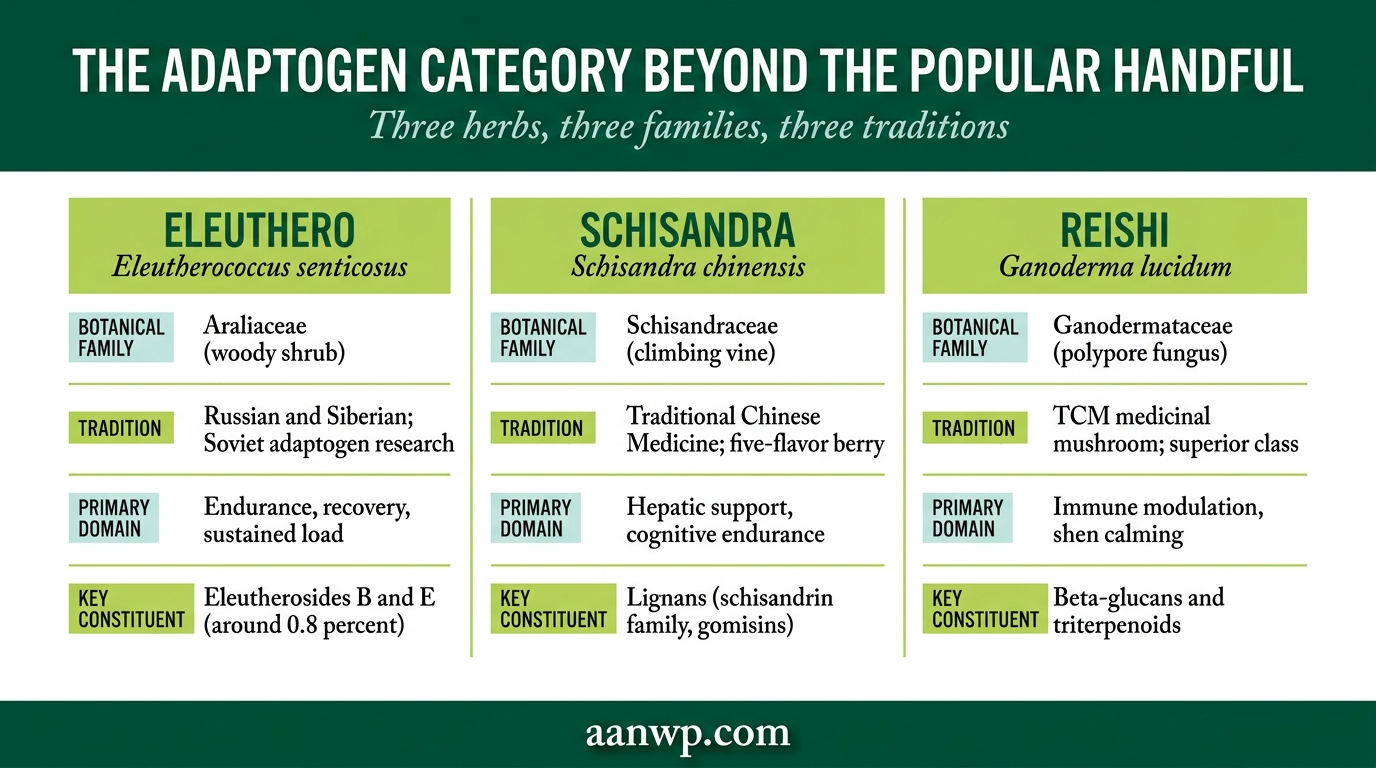
The framework that emerges across these three profiles is not a simple matchup chart in the way that the introductory adaptogen primers tend to offer. It is a sense of the territory: three herbs from three different botanical families (Araliaceae for eleuthero, Schisandraceae for schisandra, Ganodermataceae for reishi as a fungus), three different traditional lineages (Russian and Siberian, Traditional Chinese Medicine, and the TCM medicinal mushroom branch), and three different mechanism profiles (endurance and recovery, hepatic and cognitive support, immune modulation and shen calming). The credentialed practitioner who has done the materia medica work knows the geography of the category, not just the popular handful, and that geography is what lets her think across cases.
What each herb opens, in practice, is access to a clinical lane that the better-known adaptogens do not cover as cleanly. Eleuthero opens the sustained-load lane: the client whose stress is mostly demand and recovery rather than acute or emotional. Schisandra opens the hepatic-and-multi-system lane: the client whose stress pattern has a liver-digestive component the practitioner reads as central. Reishi opens the immune-and-shen lane: the client whose system has drifted into immune dysregulation alongside the stress, and who needs a slow, broad-spectrum tonic that can also calm without sedating. The practitioner who holds these three lanes in mind, alongside the more familiar adaptogens she already works with, is doing the work that natural wellness practitioners can legitimately do within a non-medical scope: matching whole-plant and whole-mushroom botanicals to the client picture, within an educational and supportive relationship.
Quality, Sourcing, and the Pitfalls Specific to Each Herb
Each of these three herbs carries its own quality and sourcing challenges that the practitioner needs to know before recommending. Eleuthero has the longest and most troubled history in the U.S. supplement market: for decades, products labeled “Siberian ginseng” or “eleuthero” were adulterated with or substituted by Periploca sepium, a different plant entirely, and authentication issues persist to this day. The practitioner who recommends eleuthero needs to recommend a supplier with verifiable authentication practices and standardized eleutheroside B and E content, not simply a product with the right common name on the bottle. The cost differential between authenticated and non-authenticated products is real but worth it.
Schisandra has fewer adulteration issues but carries a different concern: pesticide and chemical residue load on non-organic crops. The berries are processed whole, and what is in or on the berry stays in the final product.
Practitioners recommending schisandra should specifically look for certified organic sources, and ideally for products that test for residues. The other quality question on schisandra is total lignans standardization; products that do not specify lignan content vary widely in clinical potency, and the dose listed on the bottle becomes much less informative without that standardization.
Reishi has the most distinctive sourcing question of the three, and it is one that working practitioners often have to walk clients through carefully. The critical distinction is mycelium-on-grain extracts versus whole fruiting body extracts. Mycelium-on-grain products are far cheaper to produce and dominate the lower-cost end of the market; they often contain substantial starch content from the grain substrate and far less beta-glucan than fruiting body extracts. The practitioner-grade recommendation is whole fruiting body, dual-extracted (both hot water and alcohol, since beta-glucans are water-soluble and triterpenoids are alcohol-soluble), with verifiable beta-glucan content listed on the label. This kind of attention to professional-grade herbal recommendation is part of what board certification was built to support: knowing not only the herb but the supply chain that delivers it to the client.

This kind of depth, knowing the adaptogen category beyond the popular handful, knowing each herb’s tradition and constituent profile, knowing what it opens clinically and what to watch for in sourcing, is the work of a board-certified natural wellness practitioner who has put in the materia medica study. It is not a credential that can be earned through a weekend course or a payment-only certificate. It grows out of real botanical education, slow reading, and long attention to clients across time. AANWP supports natural wellness practitioners earning non-exam board certification committed to this depth of materia medica fluency.