

Sleep Architecture, Stage by Stage: What Disrupts Each Phase and What It Means for Assessment
Sleep runs in four to six cycles a night, each moving through stages N1, N2, N3, and REM, and those phases are not spread evenly across the hours. Deep slow-wave sleep loads into the first third of the night while REM lengthens toward morning, so an hour lost at bedtime costs something different from an hour lost at the alarm. The cortisol awakening response, the sharp rise in cortisol thirty to forty-five minutes after waking, gives a practitioner a readable signal about whether a client’s internal clock matches the schedule she actually keeps. ANWPB board certifies natural wellness practitioners who assess sleep at this level of detail.
A client sits across from you and reports that she is in bed by ten and up at six. Eight hours, most nights, and she has the tracker screenshots to prove it. She also reports that she wakes feeling as though she never slept at all, that the first two hours of her day are lost to a fog she cannot think through, and that by nine in the evening she is suddenly and unhelpfully alert. She wants to know what is wrong with her. The honest answer is that nothing in the number she brought you can tell either of you.
Eight hours is a container. What matters is what happened inside it. Those eight hours hold four to six cycles, and each cycle moves through phases with different jobs, different chemistry, and different vulnerabilities. Two people can sleep the same eight hours and have completely different nights. A practitioner who works with total time alone is working with the container. A practitioner who works phase by phase is working with the contents, and the contents are where the useful questions live.


The Night Moves in Cycles, Not in a Block
Human sleep alternates between two major phases: non-rapid eye movement sleep, which is further divided into stages N1, N2, and N3, and rapid eye movement sleep. NREM accounts for roughly seventy-five percent of a night, and REM takes the remainder. The body moves through all of the stages four to six times, and the cycles average about ninety minutes, with the first cycle often running shorter and later cycles running longer. A full account of the stage characteristics sits in the Physiology, Sleep Stages reference on the National Library of Medicine’s Bookshelf.
Within a single cycle the ordering is broadly predictable. Sleep begins in N1, descends through N2 into N3, climbs back up through N2, and then enters REM before the whole sequence starts over.
Later in the night the descent into N3 becomes shallower or disappears entirely, while the REM segment sitting at the top of each cycle grows longer.
The part that matters most for assessment is that the phases are not distributed evenly across the night. Deep slow-wave sleep loads heavily into the first third. REM periods start short and lengthen with each cycle, so the longest REM period of the night is the one immediately before waking. That asymmetry means an hour of lost sleep costs different things depending on which end of the night it comes off.
Consider two clients who both report six hours. The first went to bed two hours later than usual and woke at her normal time, and she lost mostly deep sleep. The second went to bed on time and woke two hours early, and she lost mostly REM. The tracker shows the same number for both. The presentations will not match, and neither will the questions worth asking.
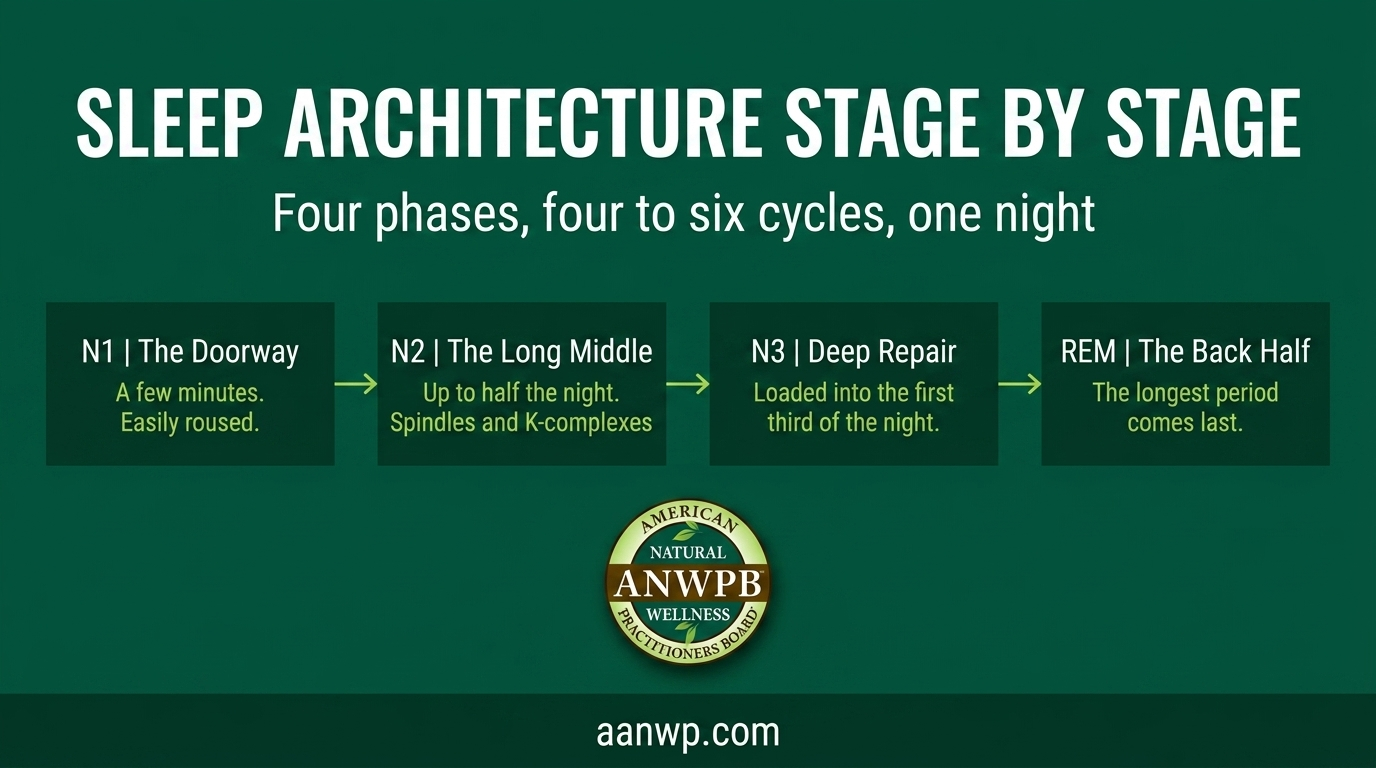
N1 and N2: The Doorway and the Long Middle
N1 is the shallowest stage and typically lasts only a few minutes. It is the transition from wake into sleep, and a person roused from it will often insist she was never asleep at all. Hypnic jerks belong here. When a client reports that it takes forty-five minutes to fall asleep, she is describing time spent at the doorway rather than time spent asleep, and the causes of a long doorway are different from the causes of a fragmented night.
N2 is the long middle. It runs roughly ten to twenty-five minutes in the first cycle and can occupy close to half of total sleep as the night goes on. Its signature features on an electroencephalogram are sleep spindles and K-complexes, and current evidence associates this stage with memory consolidation and with sensory gating, the filtering process that decides which sounds in the environment are worth waking for.
The disruptors of N1 and N2 cluster around arousal. Caffeine blocks adenosine, the molecule whose accumulation across the day produces sleep pressure, and a half-life of five to six hours means a mid-afternoon cup remains meaningfully present at bedtime. Evening light exposure delays melatonin onset and pushes the doorway later. Cognitive hyperarousal, the mind that begins working the moment the room goes quiet, keeps a person cycling back toward N1 rather than settling downward. Ambient noise and an overwarm room both operate through the same sensory-gating machinery.
The intake questions follow directly. How long from lights out to sleep, honestly estimated? Is it the mind that will not settle or the body that feels wired? When was the last caffeine, and how much? How dark and how cool is the room? Does anything wake her that she does not remember in the morning, and would a partner know if it did?
N3: Where the Repair Work Happens
N3 is slow-wave sleep, marked by high-voltage, low-frequency activity, and it runs twenty to forty minutes in the first cycle before shortening in later ones. It concentrates in the first third of the night, which is why bedtime timing matters more than most clients expect. The overnight growth hormone pulse is tied to it. Tissue repair, immune consolidation, and the clearance processes that run during deep sleep all belong to this phase.
N3 is also the hardest phase to be roused from. A person woken out of slow-wave sleep experiences sleep inertia, the heavy and disoriented state that can last twenty or thirty minutes. A client who describes her alarm as violent, who needs half an hour before she can hold a conversation, may be waking at the wrong point in a cycle rather than sleeping too little overall.

Alcohol is the disruptor most often hiding in plain sight. It shortens sleep onset and can deepen the earliest part of the night, which is exactly why clients describe it as helping. As it metabolizes, it fragments everything after. Late heavy meals, an elevated core body temperature from intense evening exercise, chronic pain, and a warm bedroom all reduce slow-wave sleep. Age reduces it as well, and normalizing that for an older client is frequently more useful than chasing a number back upward.
One pattern deserves a direct question early. Loud snoring, witnessed pauses in breathing, or gasping arousals reported by a partner point toward sleep-disordered breathing, which fragments deep sleep regardless of how well the rest of the picture is arranged. Asking about it in the first session is simply good assessment, because much of what a practitioner might otherwise work on sits downstream of it.
REM and the Back Half of the Night
REM sleep carries near-total voluntary muscle atonia, with the extraocular muscles and the diaphragm as the working exceptions. Dreaming concentrates here. So does emotional processing and the associative, cross-linking kind of memory work that differs from the consolidation happening in N2. Because REM periods lengthen across the night, the majority of a person’s REM sits in the final third.
That back-loading has a consequence a practitioner can use immediately. Any night cut short at the waking end removes REM disproportionately. A client sleeping six hours instead of eight has not lost a quarter of every phase evenly. She has lost a much larger share of REM specifically, and chronic early alarms produce a REM deficit that an earlier bedtime does not fully repair while the total remains short.
The practical move is to ask about the waking end of the night before asking about the falling-asleep end. Most clients arrive focused on how hard it is to get to sleep, because that is the part they experience consciously and the part that feels like a personal failure. The waking end is where the arithmetic actually happens. A client setting an alarm ninety minutes earlier than her body would choose is losing the phases that carry emotional regulation and associative memory, and her daytime picture will reflect that specific loss rather than reflecting ordinary tiredness.
Alcohol appears again here in a different form. It suppresses REM in the first half of the night and produces a rebound in the second, which is the mechanism behind the vivid and exhausting dreams and the reliable three-in-the-morning waking that clients describe after an evening of drinking. Nasal congestion, several common medication classes, and an irregular wake time all bear on the same territory.
Two client reports point squarely here. A client describing vivid, emotionally heavy dreams alongside early waking is describing the back half of her night. A client describing no dream recall at all across months is describing the same territory from the opposite direction. Neither observation is a conclusion on its own, but both are precise enough to be worth following.
The Cortisol Awakening Response and What Morning Reveals
Sleep architecture describes what happens across a night. Circadian rhythm describes when the night is supposed to happen. The two are separable, and a client can have well-formed cycles occurring at the wrong hours entirely. The master clock, a cluster of nerve cells called the suprachiasmatic nucleus, sets timing largely from light reaching the eyes and governs melatonin release accordingly, as the National Institute of General Medical Sciences describes in its circadian rhythms overview.
The clearest morning marker of that timing system is the cortisol awakening response. Cortisol rises sharply in the minutes after waking and peaks roughly thirty to forty-five minutes later. It is not an artifact of stress.

It appears to be functional, preparing the body for the demands of the coming day, and laboratory work using controlled circadian protocols has shown that the circadian system modulates the response independently of sleep and behavior.
For a practitioner, the first waking hour is a window into whether a client’s internal clock is aligned with the schedule she actually keeps. The client who wakes and is ready within twenty minutes, who is hungry within the hour, and whose energy tapers through the evening has a rhythm matched to her life. The client who needs two hours before she is functional, has no appetite until midday, and finds her clearest thinking at ten at night has a timing problem rather than a discipline problem. Naming that difference out loud changes the entire conversation.
The questions that open it are simple ones. What time would she wake with no alarm on a free morning? How long until she feels ready to move? When does hunger arrive? When does her energy peak, and when does it fall away? And, most usefully of all, when does light first reach her eyes, and how much light fills her evenings? Morning light anchors the clock forward. Evening light pushes it back. The client who spends her mornings indoors under weak light and her evenings under bright ones is receiving a consistent instruction to shift later, and her body is following it faithfully.
This kind of reasoning, hearing eight hours and knowing to ask which hours and which phases, is the work of a board-certified natural wellness practitioner. It is the difference between recording what a client reports and understanding where in the night the problem actually sits. ANWPB supports natural wellness practitioners earning exam-based board certification who assess at this level of resolution, practitioners who wanted their knowledge tested and their competency publicly verified rather than only reviewed.