Anyone Can Get Certified. Here Is What It Takes to Prove You Actually Know the Work.
ANWPB provides exam-based board certification for natural wellness practitioners, desiring formal examination to verify professional competency rather than relying on course completion alone. Board certified practitioners are listed on the International Registry, where their standing can be independently confirmed by clients, peers, and institutions. The credential is available through two pathways, naturopathy/natural medicine or nutrition, both governed by a practitioner advisory board and grounded in the same standard: competency should be demonstrated, not simply assumed.
You have seen it happen. Someone completes a short program, prints a certificate, and immediately presents themselves as a professional. The language sounds official. The branding looks polished. To the outside world, the whole thing appears legitimate, and there is no obvious way for a prospective client to know the difference between that person and someone who has spent years studying, applying, and deepening their knowledge of natural wellness.
The gap is not always visible from the outside. But anyone who has done the real work feels it immediately. You know what it takes to understand these principles at a level where you can apply them correctly with real people in real situations. You know that knowledge is not something you attend. It is something you earn through sustained effort and then demonstrate under evaluation.
That recognition is the beginning of a specific question.

Not “How do I get certified?” That question has too many easy answers. The question that matters for practitioners at a serious level is this: how do I prove I actually know the work? That is the question exam-based board certification through ANWPB is built to answer.
The Difference Most Practitioners Feel But Cannot Name
In natural wellness, board-certified and non-board-certified practitioners often share the same professional spaces, the same vocabulary, and sometimes even similar titles. What separates them is not always immediately apparent from the outside. The more honest observation is that the difference is felt before it is explained, both by the practitioner who has done the deeper work and by the clients and peers who are trying to evaluate professional standing without a clear external reference point.
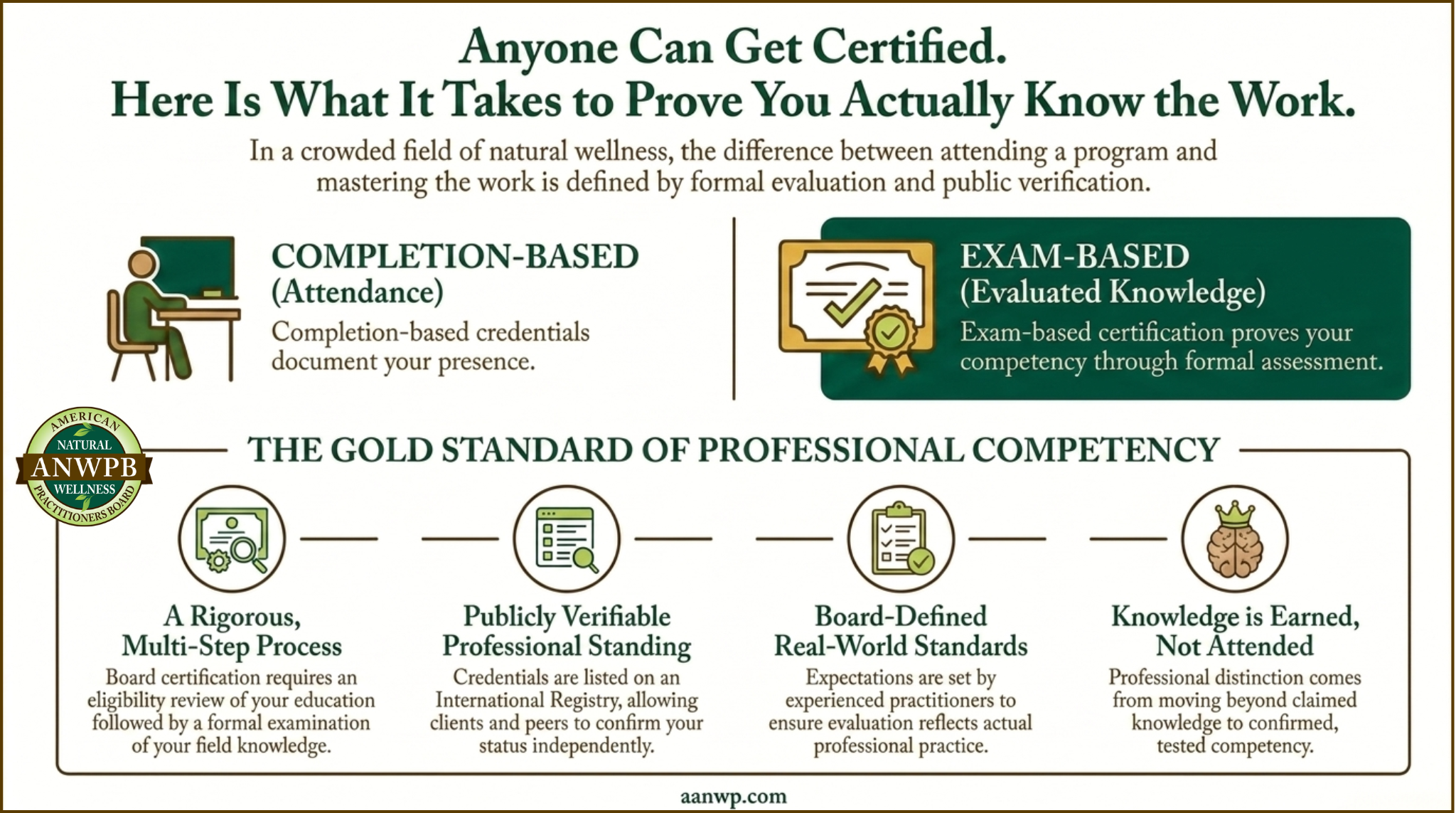
Completion-based credentials document attendance. Exam-based board certification requires something categorically different. It requires that a practitioner demonstrate their knowledge under formal evaluation, and that the result of that evaluation be placed in a public record that others can independently confirm. ANWPB provides exactly that pathway for natural wellness practitioners, with your education reviewed, your knowledge tested, and your professional standing made publicly verifiable. That is not simply a credential. That is a standard with teeth.

What Exam-Based Actually Means
The phrase “exam-based board certification” is used casually in many contexts, but within ANWPB it carries a specific and deliberate meaning. It means your knowledge is formally evaluated through examination, not assumed, not inferred from course completion, not granted as a function of having paid a program fee. The process begins with eligibility review, in which your educational background is assessed to confirm it aligns with the board’s expectations. Only after that review does the examination become the next step, and from there, competency is assessed across the body of knowledge relevant to your field.
ANWPB offers two distinct certification pathways. For practitioners pursuing naturopathy or natural medicine, the exam framework and requirements are detailed at aanwp.com/anwpb-naturopathy-natural-medicine.
For those focused on nutrition, the certification pathway and its requirements are outlined at aanwp.com/anwpb-nutrition-exam. Two pathways, one standard, both built on the same principle: competency should be provable, not simply implied.
The exam is not designed as an obstacle to entry into the profession. It exists to confirm that a practitioner meets the level of understanding expected within a recognized professional body. That confirmation is what gives the credential its weight. It is what separates ANWPB board certification from programs that confer recognition through review alone, and it is the reason the credential carries meaning in professional conversations that a completion certificate simply cannot enter.
Why Testing Changes What a Credential Means
When knowledge is tested, the nature of the credential changes in a way that matters practically. Without an examination, a credential communicates that a practitioner completed education/training. With an examination, it communicates that a practitioner met a defined standard under evaluation. That is a fundamentally different claim, and the difference becomes most visible through the mechanism that makes it real: public verification.
ANWPB-certified practitioners are listed on the International Registry, where their standing can be independently confirmed by clients, peers, collaborators, and institutions without any documentation from the practitioner themselves. You can review how the registry functions at aanwp.com/anwpb-board-certification-registry. The credential is no longer something a practitioner claims in conversation. It is something that can be looked up and confirmed by anyone with reason to ask. In a field where many credentials exist without external validation of any kind, that creates a professional distinction that is both meaningful and durable.
The distinction operates in both directions. From the outside, a publicly listed, exam-based credential communicates a specific and verifiable standard to anyone evaluating the practitioner’s background. From the inside, there is a different kind of meaning: the practitioner knows that their standing was not granted, assumed, or purchased. It was demonstrated under evaluation and documented in a record that reflects it. That combination, of external verifiability and internal earned confidence, is what exam-based board certification produces.
The Independent Board and Why It Matters
Another defining element of exam-based board certification is the question of who sets and maintains the standard. ANWPB operates with an advisory board composed of experienced natural wellness practitioners. This group shapes the expectations for both education review and the examination itself, and their composition can be reviewed at aanwp.com/advisory-board. This matters because the standard is not abstract or invented in isolation. It is grounded in real-world practice, informed by professionals who have worked in the field over time.
A practitioner who earns ANWPB board certification is not meeting a benchmark designed by administrators unfamiliar with the work. They are meeting a standard that reflects the expectations of their professional peers, people who understand what applied natural wellness knowledge looks like in practice and have defined the examination accordingly. That context changes how the credential reads, both to the practitioner holding it and to anyone evaluating it from the outside.
Exam-Based Versus Non-Exam Board Certification
A question that surfaces frequently in conversations about credentialing is what the actual difference is between exam-based and non-exam board certification, and whether one is more legitimate than the other. The honest answer is that neither is superior in an absolute sense. They are designed for different professional purposes, and the distinction between them is about what each credential accomplishes rather than which one is inherently better.
Non-exam board certification recognizes existing education through review. It is designed for practitioners who want their education formally acknowledged by an independent board without the examination requirement. AANWP operates within this model, and it provides real professional value for practitioners who want their education reviewed and their professional identity established within a recognized body. That is a legitimate pathway with a clear purpose.

Exam-based board certification is for practitioners who want to go further. They want their competency demonstrated through formal testing, not simply recognized through review. Only one of these two pathways requires a practitioner to sit for examination and demonstrate their knowledge under evaluation. That is the defining line, and practitioners who want their knowledge to be provable rather than merely acknowledged choose the exam-based path for precisely that reason. Both AANWP and ANWPB serve the practitioner lane. They serve different moments in a professional journey, and both serve that journey legitimately.
Professional Distinction in a Crowded Field
Natural wellness continues to grow as a profession. More practitioners enter the field each year. More programs become available. More credentials appear in the marketplace. With that growth comes a challenge that every serious practitioner eventually confronts: how do you establish professional distinction in a way that is both meaningful and verifiable to someone who does not already know your work?
Titles alone are not sufficient. Branding alone is not sufficient. Even education alone is not always sufficient when someone is evaluating your professional background against others in a field where the entry barriers vary enormously. Exam-based board certification addresses that problem directly. When a credential is publicly verifiable and tied to a formal examination record, it communicates something specific that a completion certificate cannot: this practitioner met a defined standard, was evaluated against it, and passed.
ANWPB board certification includes practical elements that reinforce the professional value of the credential. Certified practitioners are pre-qualified for professional liability insurance, adding a layer of practical protection aligned with operating at a higher professional standard. Certification also includes membership benefits through AANWP, providing access to resources, practitioner discounts, and professional support across the practitioner network. These are not the primary reasons to pursue board certification, but they are part of the broader professional framework that accompanies it.
ANWPB board certification also qualifies practitioners to sit for the KCNH Alternative Health Professional Level Examination (AHPLEX) exam. ANWPB is the only designation outside of state medical licensure that meets the eligibility requirement for the AHPLEX, making it a uniquely positioned credential for practitioners who are interested in an accelerated PhD. For practitioners with that pathway in view, ANWPB board certification is not simply one option among many. It is the required foundation.

Scope Awareness and Professional Clarity
A credential does not define the boundaries of practice, and no credentialing body claims otherwise. What exam-based board certification does is place a practitioner within a professional framework that takes practice boundaries seriously and provides the resources to navigate them with clarity. ANWPB provides guidance to help practitioners stay aligned with appropriate practice parameters. The scope of practice guidelines at aanwp.com/scope-of-practice-for-non-state-licensed-practitioners clarify how to operate responsibly within the natural wellness field, and the legal and ethical overview at aanwp.com/legal-ethical-essentials offers additional context that supports informed, professional practice.
Exam-based board certification does not grant scope. It exists alongside scope, within a professional framework that takes the question seriously.
That alignment matters to practitioners who have invested in the work, and it matters to the clients and collaborators who interact with them and want confidence that the practitioner operates within a recognized professional context.
There is a moment that practitioners who have completed this process often describe in similar terms. It is not the moment they receive the credential. It is the moment they stop explaining themselves and start pointing people toward a public record that confirms everything they would have said. When your board certification is listed, searchable, and tied to a formal examination record, the conversation changes. You are not asking anyone to take your word for it. You are giving them a way to confirm it independently, and that confirmation carries a weight that no self-description can replicate.
Because you know what the process required. You know it was not automatic. You know it was not assumed. Your education was reviewed, your knowledge was tested, and your professional standing is now documented in a public record that reflects exactly that. That is the shift from claimed to verified, and that shift is what separates exam-based board certification from every completion-based credential in a crowded field.
If you are ready to move from education alone to tested competency, the next step is clear. Review the certification pathways, confirm your eligibility, and begin the process.