AANWP Board Certification: What It Validates and Why It Matters
AANWP Board Certification is a professional credential that validates a practitioner’s education and role alignment within the natural wellness field. It does not grant medical authority or licensure, but it confirms that a practitioner’s education has been reviewed against defined standards. The purpose of board certification is to provide clarity and professional structure in a field with diverse educational pathways.

For many people entering natural wellness, the question is not whether they want to help others. It is how to define themselves professionally in a field that does not follow a single, government-regulated pathway. Titles vary widely. Training backgrounds differ. Public understanding is inconsistent.
Board certification exists to bring clarity into that environment. AANWP Board Certification is not about granting authority, diagnosing conditions, or practicing medicine. It is about professional validation. It establishes that a practitioner’s education has been reviewed against defined standards and that their role fits within a recognized practitioner lane.
This article explains what AANWP Board Certification validates, what it does not do, and why it matters for practitioners who want clarity, credibility, and professional structure.
What Is AANWP Board Certification?
AANWP Board Certification is a non-exam credential that recognizes a practitioner’s educational background and professional alignment within the natural wellness field.
The American Association of Natural Wellness Practitioners (AANWP) board certification is awarded through an education review process rather than an examination. The focus is on verifying that a practitioner’s completed education that meets established board standards for natural wellness practice.
This type of board certification is designed for practitioners whose education may come from:
- Formal schools or programs
- Private institutes or academies
- Completed coursework in natural or holistic wellness disciplines
The credential confirms that the practitioner’s education has been evaluated and accepted as meeting professional criteria.
What Board Certification Validates

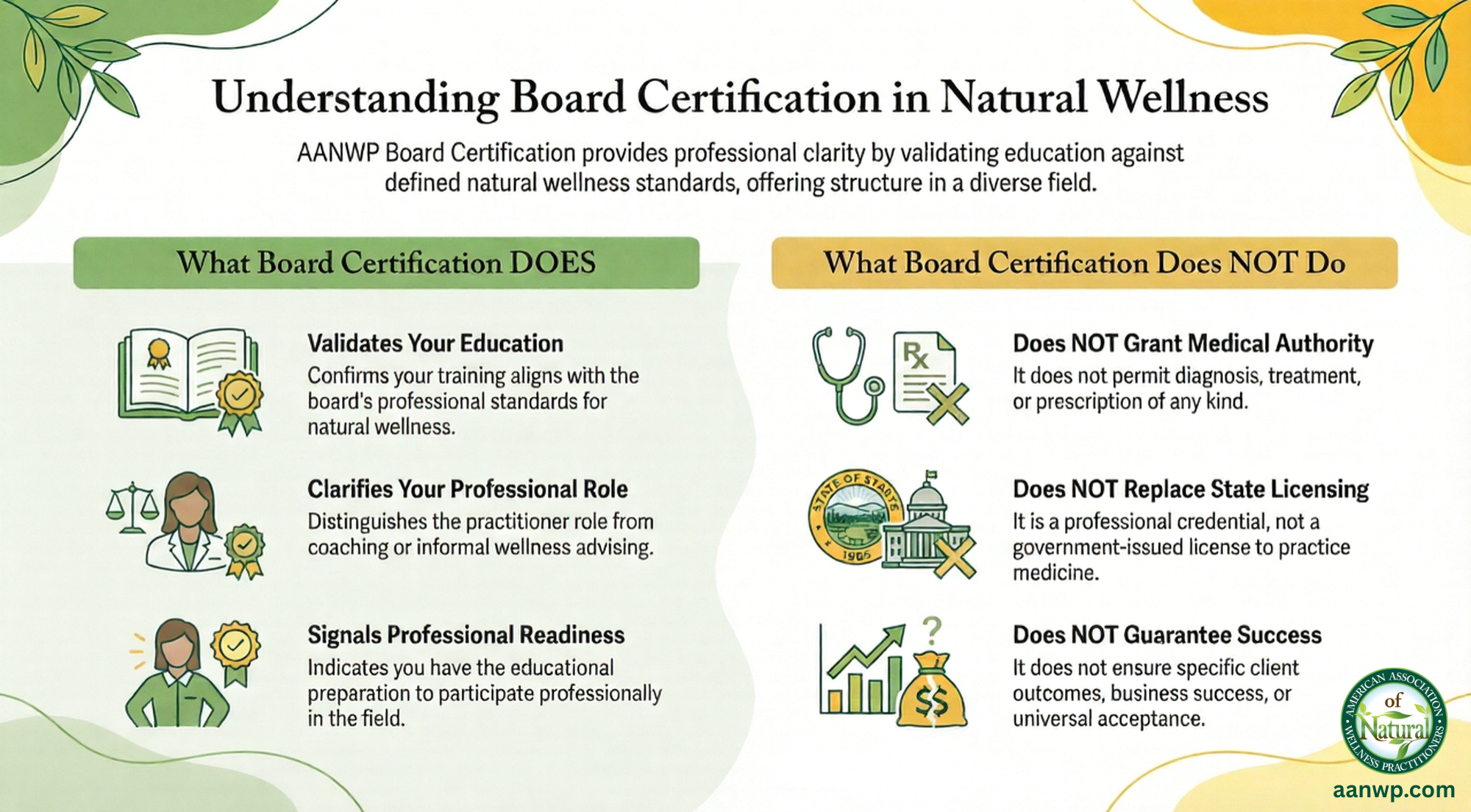
Board certification validates several important elements of professional identity. These validations help reduce ambiguity, both for practitioners themselves and for the audiences they serve.
- It validates education. The certification confirms that a practitioner has completed education relevant to natural wellness practice and that this training aligns with defined board standards.
- It validates role alignment. Board certification helps distinguish the Natural Wellness Practitioner role from other wellness-adjacent roles, such as coaching or informal wellness advising. It clarifies that the practitioner operates within a practitioner lane, not a coaching or medical one.
- It validates professional readiness. While it does not assess clinical outcomes or personal skill, board certification indicates that the practitioner has reached a level of educational preparation consistent with professional participation in the field.
What Board Certification Does Not Do
Clarity also requires understanding boundaries. AANWP Board Certification does not grant medical authority. It does not permit diagnosis, treatment, or prescription. It does not replace or override state medical licensing. It does not guarantee business success, client outcomes, or professional acceptance in every jurisdiction. Certification is a professional credential, not a promise or a license.
It also does not imply a hierarchy over other wellness roles. Coaching, education, and practitioner work serve different purposes. Board certification simply defines one of those lanes clearly. Understanding these limits is essential to using the credential responsibly and accurately.
Why Professional Validation Matters in Natural Wellness
Natural wellness remains a diverse and decentralized field. This diversity is one of its strengths, but it also creates confusion.
Practitioners often struggle with questions such as:
- How do I describe my role professionally?
- How do I demonstrate legitimacy without overstating authority?
- How do I differentiate myself from untrained or informal wellness providers?
Board certification addresses these challenges by providing a shared professional reference point. It allows practitioners to say, with accuracy, that their education has been reviewed and recognized by a professional certifying body. This kind of validation supports clearer communication, stronger professional confidence, and more consistent public understanding.
Board Certification and Professional Identity
Professional identity is not just about titles. It is about alignment. When a practitioner holds board certification, they are aligning themselves with defined standards, expectations, and ethical boundaries. This alignment helps reduce internal uncertainty and external misinterpretation.
Rather than improvising explanations or relying solely on personal narratives, practitioners can point to a recognized credential that supports their professional role. Over time, this consistency strengthens both individual credibility and the broader integrity of the natural wellness field.
Education Review vs. Exam-Based Certification
Not all board certifications function the same way. Natural Wellness Practitioner Board Certification through AANWP is review-based. It focuses on evaluating completed education rather than testing through an exam.
This approach serves practitioners whose training pathways may be varied but substantial. It recognizes that competency in natural wellness often develops through diverse educational models rather than standardized testing alone.
Some practitioners later choose to pursue exam-based board certification through a separate board authority, but this is not required. Review-based certification stands on its own as a valid professional credential.
When Practitioners Typically Seek Board Certification

Practitioners pursue board certification at different stages. Some seek it early, after completing foundational education, as a way to establish credibility from the start. Others pursue it later, after years of practice, to formalize an identity they have already been living.
There is no single correct timing. Board certification is a professional tool that can support clarity whenever a practitioner feels ready to define their role more formally.
How Board Certification Supports the Public
While board certification primarily serves practitioners, it also benefits the public. Clients and communities often struggle to understand who is qualified in natural wellness spaces. Board certification provides a visible marker that a practitioner’s education has been reviewed and that their role is defined within professional standards. This does not eliminate the need for personal discernment, but it adds a layer of transparency and accountability that supports trust.
Board Certification as a Foundation, Not a Finish Line
Board certification is not an endpoint. It is a foundation. For some practitioners, it becomes a stable professional anchor that supports long-term practice. For others, it is one step within a broader professional journey that may include additional credentials, licensing structures, or academic study. What matters is that the credential is understood accurately and used responsibly, as a validation of education and professional alignment.
One of the most important aspects of board certification is how it is communicated. Used well, it clarifies role, education, and standards. Used poorly, it can create confusion or unrealistic expectations.
Board Certification matters because it provides structure in a field that often lacks it. Its value lies in clarity, not in claims of authority or superiority. When practitioners understand this, the credential becomes a stabilizing force rather than a source of misunderstanding.
For practitioners exploring how to define their professional identity, learning more about board certification standards can be a helpful next step. Understanding how education is reviewed and what the credential represents allows practitioners to decide whether it aligns with their goals and background.