How Exam-Based Board Certification Validates Professional Competence
ANWPB exam-based board certification validates practitioner competence through a standardized online examination. Practitioners who pass are added to the ANWPB Registry and receive the professional title designation selected on their exam application. The “Doctor of” designation reflects doctor as teacher, derived from the Latin docere, and is not a degree or medical license.
In many professional fields, competence is discussed constantly. Yet when someone asks, “How do I know you’re qualified?” the answer is often less clear than expected.
You may have completed training. You may have practical experience. You may have strong client outcomes. Still, questions remain:
- What standards were you evaluated against?
- Who determined that you were ready?
- How is your competence verified beyond your own claims?
Exam-based board certification exists to address that uncertainty.
The American Natural Wellness Practitioners Board (ANWPB) provides an exam-based practitioner board certification pathway that validates competence through standardized assessment rather than coursework completion alone.
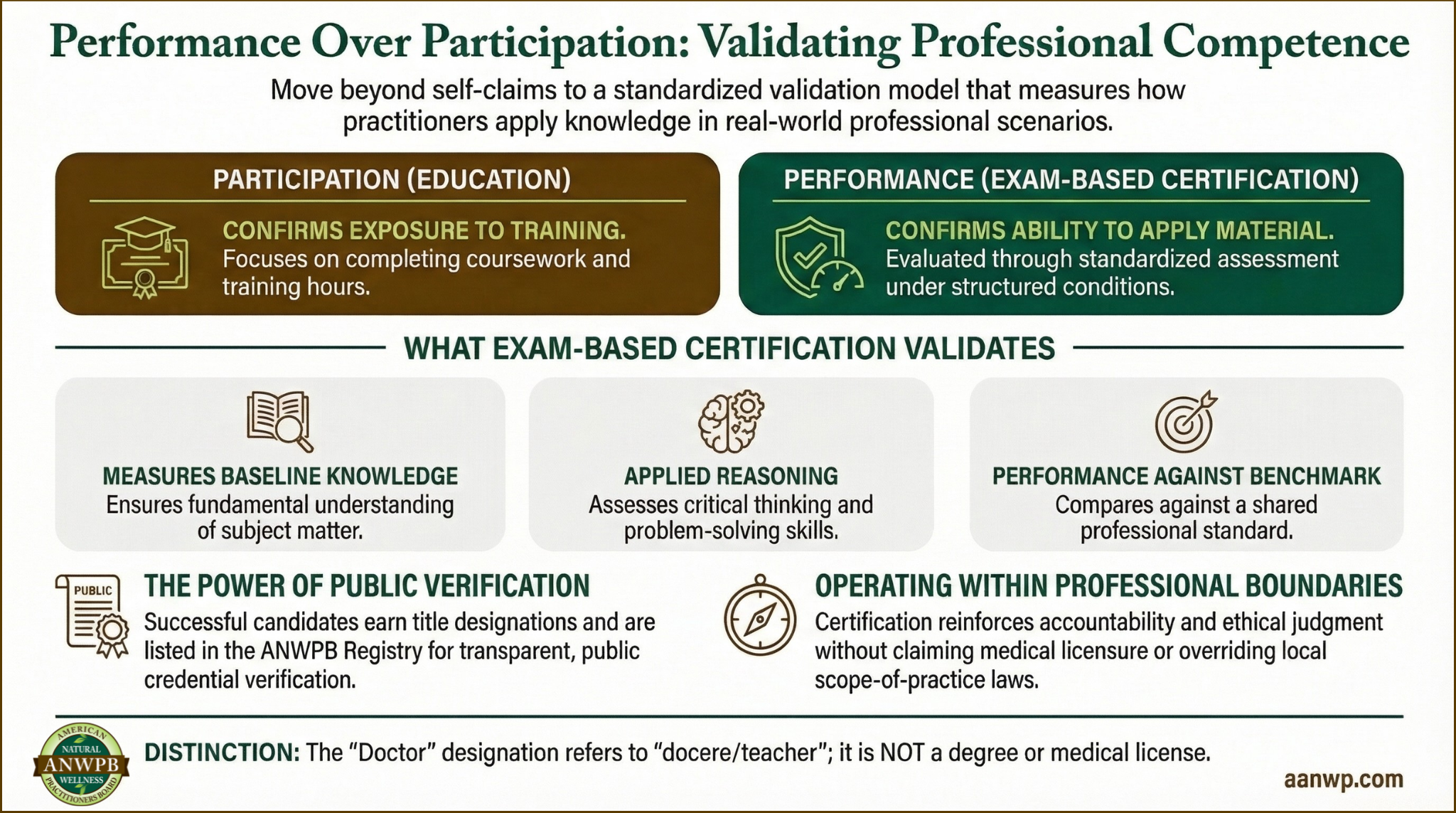
This distinction matters. It shifts professional validation from participation to performance.

This article explains what ANWPB exam-based board certification validates, what it does not claim to validate, how its institutional infrastructure supports professional clarity, and how to interpret the credential responsibly in real-world practice.
What “Professional Competence” Really Means in Practice
Competence is often treated as if it were a single trait. In reality, it is layered and practical.
Professional competence typically includes:
- Knowledge competence – understanding foundational concepts and terminology.
- Applied competence – interpreting information and choosing appropriate next steps.
- Boundary competence – recognizing scope-of-practice limits.
- Ethical competence – prioritizing client welfare and responsible conduct.
- Consistency – responding reliably across varied scenarios.
In day-to-day work, competence is demonstrated through documentation habits, careful communication, appropriate referrals, and structured decision-making.
It is rarely proven by one conversation. It is shown through repeatable judgment.
So where does an exam fit?
An exam cannot measure every dimension of professional development. It can measure whether a practitioner can demonstrate knowledge and reasoning within a standardized evaluation environment.
That is the function of the ANWPB board examination.
What ANWPB Exam-Based Board Certification Is Designed to Validate
At its core, ANWPB exam-based board certification validates three measurable dimensions:
- Baseline Professional Knowledge
The practitioner demonstrates fluency in core terminology and professional principles.
- Applied Reasoning
The exam uses structured questioning to evaluate understanding beyond memorization.
- Performance Against a Shared Standard
Every applicant is evaluated using the same benchmark.
ANWPB exams are administered online and allow two attempts per test. Preparation resources, including a study guide and prep course, are available for candidates who want structured preparation before testing.
The credential is earned by performance.
Why Exam-Based Validation Is Different from Education-Validated Certification
Education demonstrates preparation. Examination demonstrates tested application.
Completion of coursework confirms exposure to material. An examination confirms the ability to apply that material under structured conditions.
Within the practitioner lane, this creates two different credentialing models:
- Education-validated board certification
- Exam-based board certification
ANWPB operates exclusively through the examination model.
This does not imply hierarchy. It reflects different validation methods.
The Institutional Difference: Registry and Title Designation
Passing the ANWPB examination does more than produce a certificate.
Successful candidates are added to the ANWPB Board Certification Registry, which serves as public verification of exam-based status:
Registry listing is exclusive to practitioners who have passed the standardized ANWPB examination. It is not available through non-exam pathways.
Additionally, candidates receive the professional title designation selected on their exam application.
Some certifications include “Doctor of” designations. Within ANWPB, the term “Doctor” reflects its Latin origin docere, meaning “to teach.” It signifies doctor as teacher.
It is not:
- A degree
- A medical license
- Comparable or equivalent to a licensed Doctor of Medicine (M.D.)
ANWPB does not grant authority, rights, or licensure. Practitioners must consult their local, state, and federal regulations regarding scope of practice.
This clarity is intentional.

What “Standardized Assessment” Actually Means
Standardized does not mean simplified.
It means consistent.
A standardized assessment aims to:
- Maintain consistent scoring criteria
- Reduce bias
- Apply the same expectations to all candidates
- Produce comparable results across time
When done properly, standardization reduces variability in evaluation. It increases predictability in how competence is measured.
What an Exam Can Realistically Measure
Exam-based board certification is effective at measuring:
- Terminology precision
- Pattern recognition
- Scenario-based reasoning
- Ethical judgment
- Boundary awareness
- Consistency in structured decision-making
It cannot measure:
- Personality
- Long-term client rapport
- Communication warmth
- Years of experience
Understanding both strengths and limits prevents exaggeration.
ANWPB exam-based board certification signals tested competence. It does not guarantee outcomes.
What Exam-Based Board Certification Does Not Claim
It does not:
- Grant medical licensure
- Override regulatory law
- Guarantee specific results
- Replace continuing education
- Eliminate professional responsibility
All members must consult their local and state legislatures and relevant licensing bodies regarding scope-of-practice laws.
The credential validates examination performance within defined professional boundaries.
How Exam-Based Certification Supports Professional Accountability
Accountability becomes clearer when standards are explicit.
ANWPB exam-based board certification reinforces accountability by:
- Requiring eligibility review
- Administering standardized testing
- Publishing successful candidates in a registry
- Clearly defining title usage
This structure reduces ambiguity in environments where titles can otherwise be loosely used.

What “Validated Competence” Looks Like in Practice
In real professional settings, validated competence often shows up as:
- Clear intake documentation
- Accurate, non-exaggerated explanations
- Responsible boundary language
- Appropriate referrals when issues fall outside scope
- Consistent processes
- Calm decision-making under uncertainty
The exam does not create these behaviors automatically. It confirms that the practitioner has demonstrated knowledge consistent with developing them.
How Exam-Based Board Certification Affects Public Confidence
Different audiences interpret credentials differently.
For Clients
Clients often lack the training to evaluate competence directly. They look for visible signals of evaluation.
ANWPB exam-based board certification provides:
- A defined benchmark
- Registry confirmation
- Clear title designation
- External validation beyond self-claims
For some clients, knowing that a practitioner passed a standardized board examination reduces uncertainty.
For Peers
Peers value shared benchmarks. Exam-based certification provides a common reference point when comparing backgrounds.
For Institutions
Organizations evaluating practitioners often look for standardized credentials. An exam-based credential provides structured verification rather than subjective interpretation.

Additional ANWPB Benefits:
ANWPB board-certified practitioners will also receive:
- Pre-qualification pathway for professional liability insurance
- Introductions to companies offering supplements, devices, labs, equipment, laboratories, and education
- Discount codes and professional offers
- Structured exam preparation materials
Scope, Ethics, and Regulatory Awareness
ANWPB also provides resources that help practitioners think carefully about professional boundaries:
Unlicensed Wellness Professional Guidelines Video:
https://aanwp.com/legal-ethical-essentials/
Scope of Practice Guidance:
https://aanwp.com/scope-of-practice-for-non-state-licensed-practitioners/
Naturopathic State Laws Map:
https://aanwp.com/naturopathic-state-laws/
Exam-based validation is meaningful only when paired with responsible scope awareness.
Common Misconceptions About Exam-Based Board Certification
Misconception 1: Passing an exam means you are automatically highly skilled.
Exams measure specific competencies. Skill deepens through practice and continued learning.
Misconception 2: Competent professionals do not need exams.
Some practitioners are competent without formal testing. However, exams provide external verification that others can recognize.
Misconception 3: Exams are only memorization.
Well-designed certification exams evaluate application, judgment, and reasoning.
Misconception 4: Certification guarantees client outcomes.
No credential guarantees outcomes. Responsible practice always involves uncertainty.
The Role of Ongoing Professional Development
ANWPB Exam-based board certification is not an endpoint. It is a validation point.
Healthy professional development often includes:
- Continuing education = 12 are required annually
- Peer collaboration
- Self-reflection
- Skill refinement
- Ethical vigilance
Certification validates readiness. Practice builds depth.
Communicating Credentials Clearly
Professional credibility increases when credentials are communicated accurately.
ANWPB exam-based board certification provides a straightforward statement:
Your competence has been evaluated through standardized examination, your credential designation has been awarded as selected on your application, and your status is publicly verifiable through the ANWPB Registry.
That clarity is often what professionals are seeking.

Deciding Whether ANWPB Is Right for You
ANWPB exam-based board certification may align with your goals if you want to:
- Demonstrate competence through standardized assessment
- Receive the professional title designation selected on your exam application
- Be listed in the ANWPB Registry
- Strengthen professional differentiation
- Provide clients with verifiable credential status